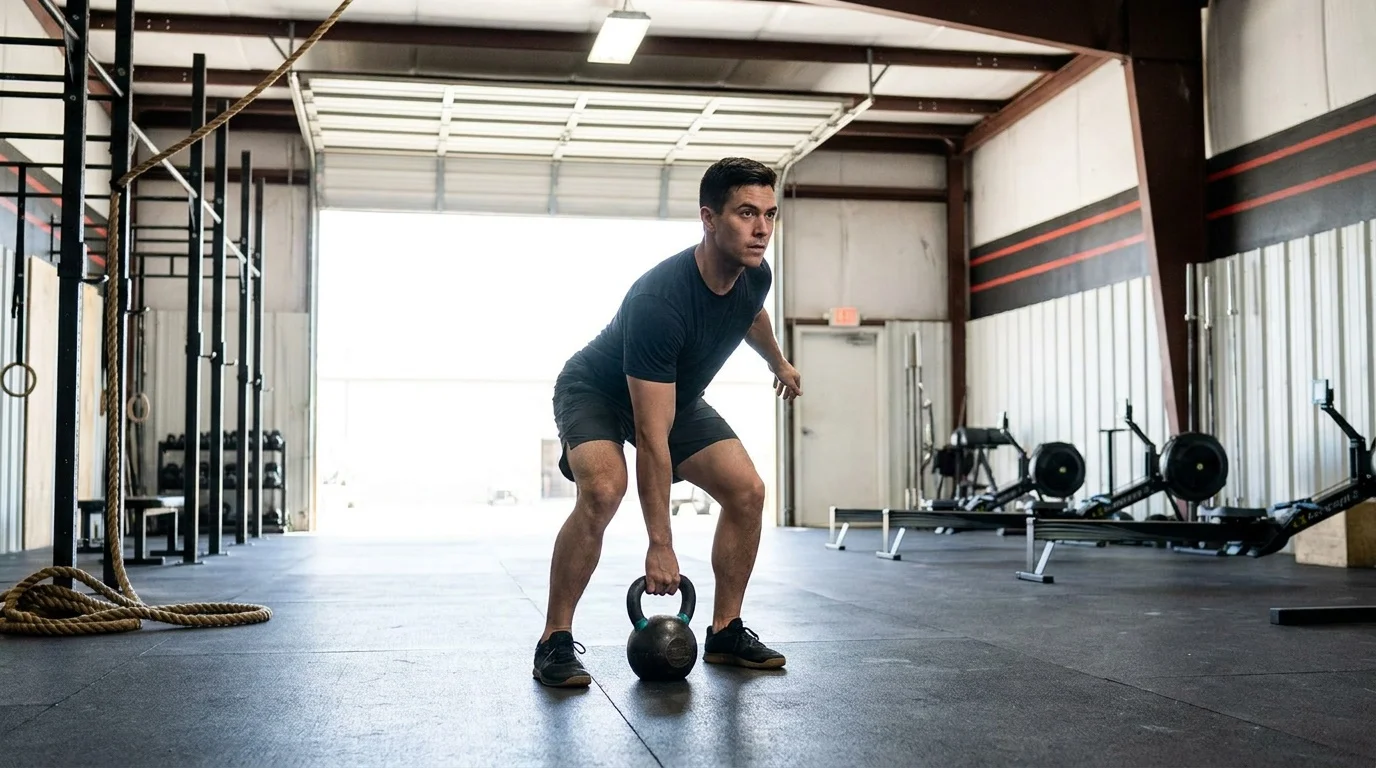
That first step out of bed feels like stepping on a bruise. It eases up by the end of your warm-up, then bites again after you sit at your desk or finish the run. If you're in the middle of a training block, maybe a couple of weeks out from the Des Moines Marathon, you want one answer: can you keep running with plantar fasciitis, or are you about to make it worse?
Here's the good news. Most runners I work with keep running through most of their recovery. The trick is knowing which runs your heel can handle and which ones it can't. In this guide I'll give you the three rules I use to decide run, modify, or stop, the changes to your running that take load off the heel, the strength work that makes it stick, a sample ramp back to full training, and the red flags that mean stop and get it checked.
The short answer
Yes, most runners can keep running with plantar fasciitis if pain stays at 3 out of 10 or lower during the run, the next morning's first steps are no worse than usual, and the week trends better, not worse. Cut the volume, don't go to zero. Stop if the pain builds as you run.
If you want the background on what plantar fasciitis is and why it hurts most in the morning, start with my guide on why your heel hurts every morning. This article is the runner's playbook.
Can you run with plantar fasciitis? My 3 rules
I don't decide by the calendar. I decide by how your heel responds. These three checks come from the pain-monitoring approach researchers used with athletes who kept training through Achilles tendon pain [1]. In my experience the plantar fascia responds to load in a similar way: it needs load to rebuild, but it can't handle too much of it at once. So I use the same rules.
Rule 1: Keep it at 3 out of 10 during the run
On a 0 to 10 scale, where 0 is nothing and 10 is the worst pain you can imagine, keep the heel at 3 or lower while you run. A little awareness is fine. Pain that climbs mile by mile is not. If it hits 4 or keeps rising, walk it in and shorten the next run.
Rule 2: The next-morning test
Your first steps the next morning are the real scorecard. If they feel the same as usual or better, that run was a dose your heel could handle. If they're clearly worse, the run was too much, even if it felt fine at the time. Scale back the next one.
Rule 3: Watch the weekly trend
One rough morning isn't a crisis. Look at the week. If your morning pain is creeping down over 7 to 10 days, keep going and build slowly. If it's flat or climbing, the load is too high. Cut back before you add anything.
Is it plantar fasciitis or a heel stress fracture?
Before you follow any running plan, make sure you're dealing with plantar fasciitis. Runners can also get a stress fracture in the heel bone (the calcaneus), and that needs a very different plan.
The patterns are close to opposite. Plantar fasciitis hurts most on the first steps after rest and loosens up as you move. A calcaneal stress fracture usually starts after a jump in training or a switch to harder surfaces, hurts more the longer you're on your feet, and can start to hurt even at rest [2].
Stop running and get it checked if:
- Squeezing the sides of your heel bone between your thumb and fingers hurts. A positive squeeze test suggests a stress fracture [2].
- The pain is spread across the heel bone, not one spot on the inside bottom of your heel.
- The pain builds through every run and stays sore for hours afterward.
- Your heel is swollen, or it aches at rest or at night.
- You're limping.
A normal X-ray doesn't rule it out. Heel stress fractures often don't show on X-rays, so an MRI or a bone scan may be needed [2].
What to change when you're running with plantar fasciitis
The goal is to lower the load on your heel enough to pass the three rules while you keep as much of your running as you can. Here are the levers I pull, roughly in this order.
Cut the volume, keep the rhythm
Shorten your runs before you skip days. If you normally run five days a week, keep four or five shorter runs instead of two long ones. Regular, tolerable doses help the tissue adapt.
When you build back, go slowly. In a study of 874 new runners, those who increased their weekly distance by more than 30% over two weeks had more of the overuse injuries tied to running distance than those who increased it by less than 10% [3].
Run flat and easy first
Hills, speedwork, and long runs put the most stress through the foot and calf. Drop them first and bring them back last. In my experience, flat, forgiving surfaces like a groomed trail or a track are easier on an irritated heel than hills or uneven ground, but let the next-morning test tell you what works for you.
Shorten your stride a little
Take slightly quicker, shorter steps. A well-known study found that raising step rate 5 to 10% above a runner's normal cadence reduced braking force and the load absorbed at the hip and knee [4]. That study didn't measure the plantar fascia. Still, a shorter stride usually means you land closer under your body instead of reaching out in front, and many of my runners say their heel feels calmer with it. Use your watch: if you run at 160 steps a minute, try 168 to 172.
Shoes and inserts
Now is not the time to switch to minimal or zero-drop shoes. Stay in a shoe with a cushioned heel that you already trust. The 2023 clinical practice guideline on heel pain recommends prefabricated or custom foot orthoses that support the arch or cushion the heel [5]. An off-the-shelf insert or heel cup is a reasonable first step, especially if taping helps.
Tape it for the short term
Taping can take the edge off while the real work happens. The same guideline recommends antipronation taping, such as low-dye taping, for short-term pain relief over the first few weeks [5]. Think of it as a bridge. It buys you comfortable runs while the strength work does its job.
The strength work that makes it stick
Running changes lower the load. Strength work raises what your heel can handle. You need both.
The best-studied exercise is a slow, heavy heel raise with a rolled towel under your toes. In a randomized trial, people with plantar fasciitis who did this high-load version had much better foot function at three months than people who only stretched [6]. I break down that protocol in my plantar fasciitis guide.
Here's the catch: heel raises alone often aren't enough. In a later trial, 12 weeks of heavy heel raises didn't get most people to a symptom level they were happy with, whether they followed a set plan or chose their own loads [7]. That's why I pair strength work with the running changes above, not one or the other.
What I usually add for runners:
- Slow heel raises with the towel, every other day, building toward real load (a backpack or a dumbbell) as your heel allows.
- Bent-knee calf raises to load the soleus, the deeper calf muscle that takes a big share of the force when you run.
- Foot strength, like toe curls and short-foot holds, to build the arch.
- Calf strength in general. If your Achilles complains too, my guide to Achilles tendon pain in runners and lifters covers how I load it.
A sample return-to-run ramp
Every runner's timeline is different, so treat this as a framework, not a schedule. Move to the next stage only when you pass the three rules at the current one.
| Stage |
What it looks like |
Move on when |
| 1. Run-walk |
Flat ground, easy pace, short run intervals with walk breaks (for example, 1 minute run and 1 minute walk for 20 to 30 minutes) |
Three sessions in a row stay at 3/10 or lower with no next-morning flare |
| 2. Easy continuous runs |
20 to 30 minutes, flat and easy, every other day |
One week of runs with morning pain steady or improving |
| 3. Build volume |
Add time or distance gradually, one change at a time |
Two weeks of steady progress with no setbacks |
| 4. Full training |
Bring back hills, then speedwork, then the long run |
Morning pain mostly gone and the heel stays quiet after hard sessions |
On non-running days, the bike or the pool keeps your fitness up without loading the heel. If you get a flare, drop back one stage for a few days. That isn't failure. It's the plan working.
Should you race on it?
If race day is close, the same rules apply. A heel that is mild, stable, and passing the next-morning test may get you through a race, especially if you've kept running in training. A heel that is getting worse week to week is telling you the answer. I cover how to sort last-minute aches in Two Weeks Out From the Des Moines Marathon. If you're unsure, get it looked at before race week, not after.
When to get help
Get your heel assessed if:
- It isn't clearly better after 4 to 6 weeks of smart changes.
- You're limping, or the pain is changing how you run.
- You have night pain, swelling, numbness, or tingling.
- Any of the stress fracture signs above show up.
Not sure if it's time? My guide on when an athlete should see a physical therapist walks through it, and here's what happens on your first visit. We treat plantar fasciitis in Waukee with the same load-based approach you've read about here.
Frequently asked questions
Should I stretch before I run with plantar fasciitis?
Calf and plantar fascia stretches can ease symptoms, and the 2023 guideline includes them [5]. Do them, but don't count on stretching alone. In my experience, a few minutes of walking and some easy calf raises make a better warm-up for an irritated heel than long static holds right before you run.
Do heel cups or insoles help?
They can. The 2023 guideline supports prefabricated or custom orthoses that support the arch or cushion the heel [5]. They work best as support around the strength work, not as the whole fix.
Can I bike or swim instead of running?
Yes. Cycling, swimming, and pool running keep your fitness up with much less load on your heel. I use them to fill the gap while your runs are short, not to replace running for good.
How long until I can run normally again?
It varies. Plantar fasciitis usually takes weeks to months to settle, not days, and many runners keep running in some form the whole time. The heavy heel raise trials ran for three months [6, 7], which is a fair picture of how long the rebuild takes.
The bottom line
You can usually keep running with plantar fasciitis if you let your heel set the pace. Keep pain at 3 out of 10 or lower, use the next-morning test, and watch the weekly trend. Cut volume before you cut days, run flat and easy, shorten your stride, and support the heel with shoes, inserts, or tape while heavy heel raises rebuild it. Rule out a stress fracture first, and get help if progress stalls.
If your heel is fighting your training plan, book a free discovery call and let's get you back to running without that first-step dread.
Medical disclaimer: This article is for educational purposes and is not personal medical advice. Consult a healthcare provider about your specific situation. Individual results may vary.
References
- Silbernagel KG, Thomeé R, Eriksson BI, Karlsson J. Continued sports activity, using a pain-monitoring model, during rehabilitation in patients with Achilles tendinopathy: a randomized controlled study. American Journal of Sports Medicine. 2007;35(6):897-906. https://journals.sagepub.com/doi/abs/10.1177/0363546506298279
- Tu P. Heel Pain: Diagnosis and Management. American Family Physician. 2018;97(2):86-93. https://www.aafp.org/pubs/afp/issues/2018/0115/p86.html
- Nielsen RO, Parner ET, Nohr EA, Sørensen H, Lind M, Rasmussen S. Excessive progression in weekly running distance and risk of running-related injuries: an association which varies according to type of injury. Journal of Orthopaedic & Sports Physical Therapy. 2014;44(10):739-747. https://www.jospt.org/doi/10.2519/jospt.2014.5164
- Heiderscheit BC, Chumanov ES, Michalski MP, Wille CM, Ryan MB. Effects of step rate manipulation on joint mechanics during running. Medicine & Science in Sports & Exercise. 2011;43(2):296-302. https://doi.org/10.1249/MSS.0b013e3181ebedf4
- Koc TA Jr, Bise CG, Neville C, Carreira D, Martin RL, McDonough CM. Heel Pain, Plantar Fasciitis: Revision 2023. Journal of Orthopaedic & Sports Physical Therapy. 2023;53(12):CPG1-CPG39. https://www.jospt.org/doi/10.2519/jospt.2023.0303
- Rathleff MS, Mølgaard CM, Fredberg U, et al. High-load strength training improves outcome in patients with plantar fasciitis: a randomized controlled trial with 12-month follow-up. Scandinavian Journal of Medicine & Science in Sports. 2015;25(3):e292-e300. https://onlinelibrary.wiley.com/doi/10.1111/sms.12313
- Riel H, Jensen MB, Olesen JL, Vicenzino B, Rathleff MS. Self-dosed and pre-determined progressive heavy-slow resistance training have similar effects in people with plantar fasciopathy: a randomised trial. Journal of Physiotherapy. 2019;65(3):144-151. https://www.sciencedirect.com/science/article/pii/S183695531930058X