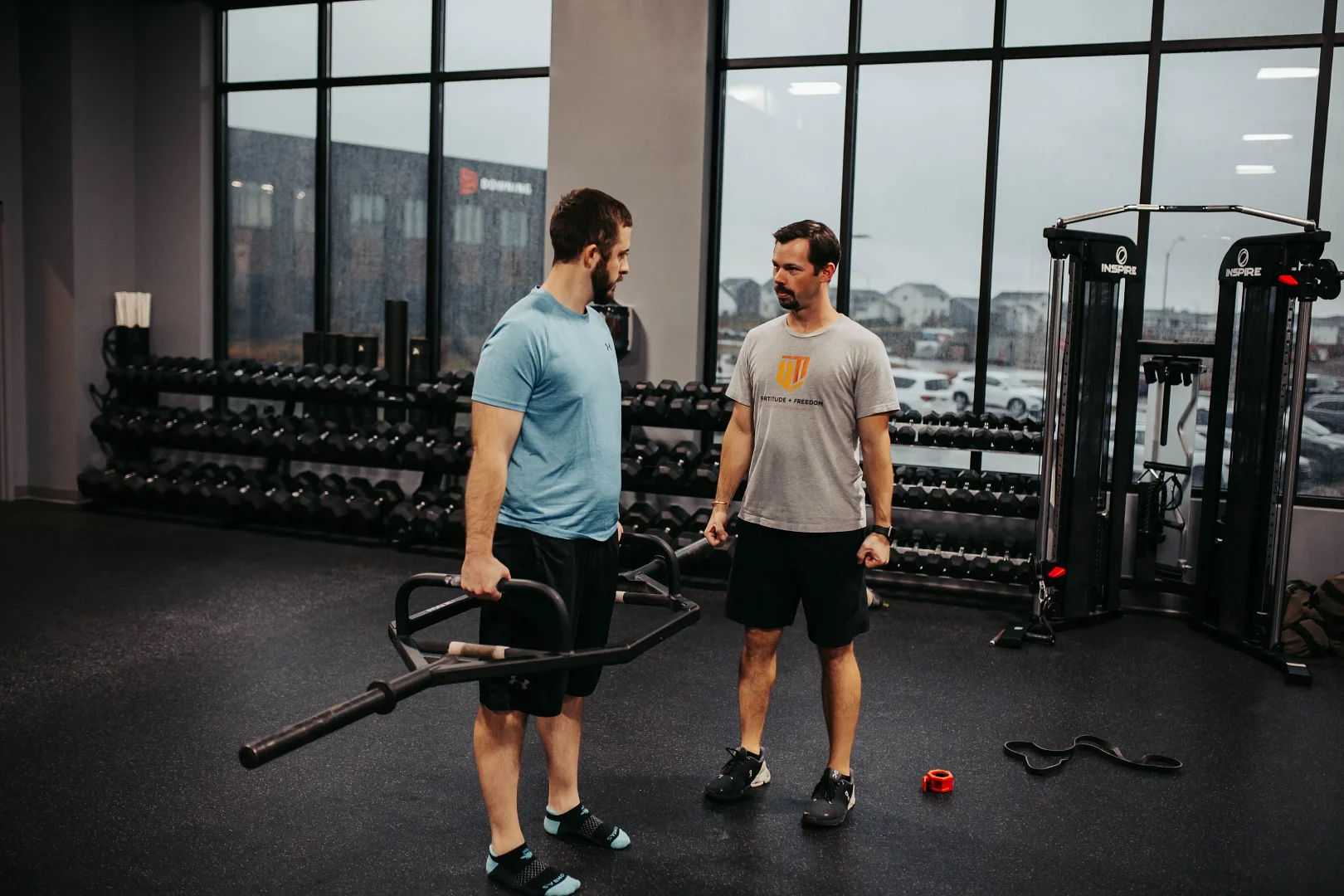
You booked the appointment. Now you are wondering what you actually walk into on day one, how long it takes, and whether you are going to leave with a plan or just a list of stretches.
Fair question. A lot of athletes put off getting looked at because they do not know what the visit is, and the unknown is easier to avoid than to schedule it.
So here is the whole thing, start to finish. This is what I do in a first sports physical therapy evaluation at Fortitude & Freedom, what I am looking for, and what you have in your hands when you walk out.
The short answer: an hour, one on one, and you start the same day
A first sports physical therapy evaluation with me is a full hour, one on one. Roughly the first fifteen minutes are questions about your training and your symptom. Then I test movement and strength against the demands of your actual sport, lifting or running, and I write down real numbers. Then we start treatment in that same visit.
You leave with a working diagnosis in plain language, your baseline numbers, and a short plan for the week. In Iowa you do not need a physician referral to be evaluated or treated by a physical therapist.
The first fifteen minutes are questions, not tests
The single most useful tool I have in an evaluation is the conversation.
Before I put hands on anything, I want the story. When did it start, and what were you doing that week? Not just the session it showed up in, but the block leading into it. A back that got angry on a heavy pull the same week you added two sessions and cut sleep is a different problem than a back that has been grumbling for eight months.
Then I want to know how it behaves. What aggravates. What calms it down. Does it hurt on the first rep or the fifteenth? Is it worse walking into the gym or walking out? Does it wake you up at night?
The research on musculoskeletal assessment backs this up: forming a working diagnosis is about synthesizing the history, observation, movement analysis, and testing together, and history quality tracks closely with getting the diagnosis right. The special tests confirm or rule out. The story is what tells me which tests are worth running in the first place.
I also want to know what you are training for. A meet in eleven weeks, a HYROX in the spring, or just being able to get on the floor with your kids are three different targets, and they change the plan.
What I test on a lifter versus a runner
This is where the eval stops being generic.
If you are a barbell athlete, I want to see the lift. Loaded, not mimed. I am watching where the position breaks down, at what load it breaks down, and whether the pain shows up with the position or with the fatigue. Then I test the pieces underneath it: hip and ankle capacity in the squat pattern, what your trunk does under load, how the shoulder behaves in the positions your sport actually demands.
If you are a runner, I am looking at single-leg loading, calf capacity through full range and to real fatigue, hopping, and how you move at the speeds you actually train at.
Either way, strength testing produces a number.
Force output on the limb that hurts and the limb that does not
Reps to fatigue, not just a one-off effort
Range of motion measured, not eyeballed
Pain behavior tracked across the test, so we know whether load makes it worse or better
The specific positions and loads that reproduce your symptom
That last one matters more than people expect. If I can reproduce your pain on demand in the clinic, I can also measure whether it is changing. "It feels a little better" is hard to build a plan on. "You could do four reps at that load before, now you can do eleven" is not.
You get those numbers. They are your baseline, and we retest them.
Why I test instead of guessing about when you go back
Somewhere along the way, return to sport turned into a calendar question. Six weeks. Three months. Wait until it does not hurt.
I do not run it that way, because the evidence says the calendar is a poor predictor and so are the simple symmetry rules people lean on.
The most common return to sport standard has been a 90 percent limb symmetry index, meaning the injured side gets within 10 percent of the other side. It sounds reasonable. The problem is that both limbs decline after an injury, so symmetry can look fine while true capacity is still well down. JOSPT published work showing limb symmetry indexes can overestimate function, and a recent critical analysis found that symmetry cutoffs did not separate athletes who returned safely from those who got hurt again.
So symmetry is one input, not the verdict. What I am actually building toward is capacity at the demand of your sport, on both sides, with pain that behaves predictably under load.
That is the whole idea behind criteria-based progression, which I go deeper on in return to sport physical therapy. The short version: we agree on what you have to be able to do, we measure it, and when you hit it you go.
Being ready is physical and psychological, and I test both
Here is the part most evaluations skip.
Roughly half of athletes who never get back to their sport point at fear of reinjury as the reason, not a physical limitation. And in the research, functional tests did not predict who returned to sport, while readiness measures did. Fear of reinjury is the leading reason athletes fail to return, and it is modifiable.
So I ask about it directly on day one. How confident are you loading that position right now? What are you avoiding in your training that you have not mentioned? What would you have to feel to put your normal weight back on the bar?
I ask because confidence is a real training variable and because it is trainable. An athlete who is strong enough but braced and hesitant is going to move badly and feel it. The fix is usually exposure done in the right order, at loads that succeed, so the belief catches up to the capacity.
You will not get a lecture about being tough. You will get a plan that rebuilds trust in the thing that hurt.
You start treatment on day one
You are not coming in for an hour of paperwork and a follow-up.
Once I have the picture, we go to work in the same visit. That is hands-on treatment where it helps, dry needling when the presentation calls for it, and the first loading exercises, done under my eye so I know they are right before you take them home.
If you have wondered whether needling is worth trying, I have written about what it does and does not do for shoulder pain and for knee pain.
You leave with three things: a working diagnosis in plain language, your baseline numbers, and a short list of what to do between now and the next visit. Short on purpose. A program you will actually finish beats a program that looks impressive.
You also leave knowing what we do with your training in the meantime. In most cases you keep lifting or keep running, with the specific things we modify named clearly. Shutting the whole thing down is rarely the answer, and it is usually the thing athletes are most afraid I am going to say.
The logistics, stated plainly
You do not need a referral. Iowa has been an unrestricted direct access state since 1988, which means I can evaluate and treat you without a physician sending you first. If you want the longer version of what that means, I wrote it up in what orthopedic physical therapy actually is.
The visit is a full hour, one on one. Not an hour in the building. An hour with me. Fortitude & Freedom is a hybrid practice (insurance and cash pay), so the number of visits and what we do in them is a decision you and I make together. Getting in early tends to mean fewer total visits, which is what the direct access research has found as well.
I refer out when I should. Part of an evaluation is screening for the things that are not mine to treat. If something in your history or exam needs a physician, imaging, or another specialist, I will tell you that on day one and help you get there.
What to bring, and what to wear
Wear what you train in. If your problem shows up in the squat, I want to see your knees and hips move, so bring shorts. If you have imaging or notes from another provider, bring them, but do not go chasing them down before your appointment. We do not need them to start.
Bring your training log if you keep one. It is the closest thing to hard data on what your body was actually asked to do in the weeks before this started, and it often answers the question faster than anything I test.
The bottom line
A first visit is an hour of my full attention, about fifteen minutes of it spent listening. You get testing built around your sport instead of a generic screen, real numbers as a baseline, treatment the same day, and a plan aimed at the thing you are actually training for.
You do not need a referral, and you do not need to wait until it gets bad enough to justify the appointment.
If something has been nagging you and you are tired of guessing at it, get in touch and book an evaluation. Let's get you back to training with confidence. The full approach is on the sports physical therapy page.
This article is for general education and is not personal medical advice. Individual results vary. If you have an injury or a medical concern, consult a qualified healthcare provider.