You stretch your lower back every morning. You touch your toes, you pull a knee to your chest, maybe you hang off the edge of the couch for a minute. It feels better. An hour later, or by the time you've finished a set of deadlifts, it's back.
That's not you doing it wrong. Stretching does something real for a stiff, achy low back. It just doesn't do the thing most people think it does, which is why the relief keeps expiring.
Here's what I give athletes and active adults in my clinic in Waukee: the lower back stretches that are actually worth your ten minutes, the honest reason they stop working on their own, and the loading that makes the relief stick for more than an afternoon.
Why Stretching Feels Good and Then Stops Working
When you stretch a muscle for a few weeks and your range improves, the muscle usually hasn't gotten longer. Your nervous system has gotten more comfortable at that depth.
A review in the Scandinavian Journal of Medicine and Science in Sports pooled 26 studies of stretching programs lasting three to eight weeks. The programs increased extensibility and tolerance to tensile force. They did not change the mechanical properties of the muscle or the tendon. The adaptation happened at a sensory level.
That matters for your back in two ways.
The good news: the relief is genuine. Turning down a protective, guarded response is a real effect, not a placebo. If your back feels looser and you move better for the next two hours, you got something.
The catch: nothing about the stretch changed your capacity. The tissue that got irritated by eight hours of sitting, or by a heavy pull you weren't ready for, is exactly as ready for that stress tomorrow as it was yesterday. So the pain comes back on the same schedule, and you end up stretching every morning forever.
If that cycle sounds familiar, I wrote about the pattern itself in why does my back keep going out.
The 5 Stretches I Actually Give for Low Back Pain
Notice something about this list: four of the five aren't your low back.
That's deliberate. A lumbar spine that hurts is often a lumbar spine doing a job that belongs to the hips or the mid-back. Stretch the segments on either side of it and the back gets to stop compensating.
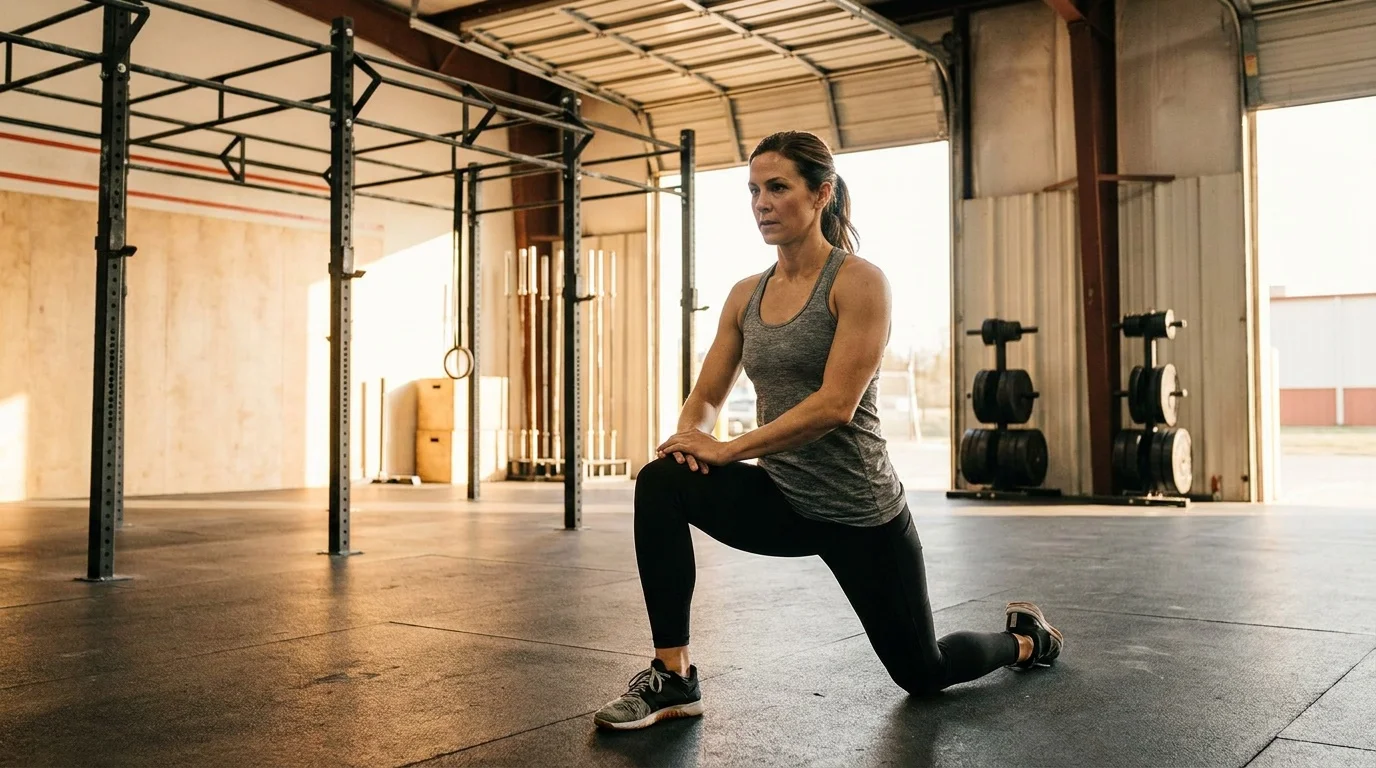
1. Half-kneeling hip flexor stretch. Back knee down, front foot flat. Tuck your pelvis under you (think "ribs down, tailbone forward"), then shift your weight gently forward. You should feel this in the front of the hip of the down leg, not in your low back. If you feel it in your back, you've arched instead of tucking. Hold 30 seconds, twice each side.
2. Supine figure-4. On your back, ankle crossed over the opposite thigh, pull that thigh toward your chest. This hits the glute and the deep hip rotators. Hold 30 seconds, twice each side. This is the one most people feel immediately if their pain wraps into the hip or the side of the glute.
3. Hamstring stretch, lying down. On your back, one leg straight up, hands behind the thigh, knee nearly straight. Keep the other leg flat on the floor. Lying down matters: standing and reaching for your toes loads your lumbar spine in flexion, which is often the position that already hurts. Hold 30 seconds, twice each side.
4. Open-book thoracic rotation. Side lying, knees bent and stacked, arms together in front of you. Keep the knees down and rotate the top arm open toward the floor behind you, following your hand with your eyes. Most desk-bound lifters have almost no rotation here, so the low back supplies it. 8 to 10 slow reps each side. I filmed this one, so you can watch me walk through the thoracic rotation stretch.
5. Cat-cow. On hands and knees, move slowly between a rounded back and an arched back. This one actually is your low back, and it's on the list because it's the only one here that's a movement rather than a hold. Your spine gets fluid, lubricated range in both directions. 10 slow reps.
Ten to twelve minutes, daily if it helps. If a stretch makes your pain worse, or sends pain down your leg, stop that one and read the warning signs section below.
What Stretching Can't Do
This is where I have to be straight with you, because the research here is pretty consistent and it's the reason a stretching-only plan plateaus.
A 2022 analysis in the Journal of Orthopaedic and Sports Physical Therapy ran a regression across systematic reviews of exercise trials for chronic low back pain, specifically accounting for risk of bias in the underlying studies. Motor control and stabilization training showed the largest effects. Stretching showed the smallest.
A network meta-analysis in Frontiers in Physiology compared eight different exercise types for non-specific low back pain. Pilates, yoga, and walking produced reductions in pain and improvements in function. Core stability training produced significant pain relief. The evidence for stretching came back inconclusive.
And the guidelines agree on the bigger picture. A review in the European Spine Journal looked at 12 clinical practice guidelines for non-specific low back pain and found exercise therapy and physical activity recommended consistently across nearly all of them, whatever the duration of symptoms.
Read that together and the message isn't "stretching is useless." It's that stretching is the entry point, and loading is the treatment. The stretches buy you a window where you move better. What you do inside that window decides whether the pain comes back.
The Loading That Makes the Relief Stick
Four movements. Two or three sessions a week. This is the part that changes your back's capacity instead of its comfort.
- Hip hinge. A kettlebell deadlift or a Romanian deadlift, loaded light enough that your back stays neutral the whole way. You're teaching your hips to do the bending so your lumbar spine doesn't have to. 3 sets of 8. Here are my Romanian deadlift progressions, easiest to hardest.
- Anti-extension work. Dead bugs, or a plank with real attention to keeping your ribs down. Your trunk's job in life is to resist movement, not create it. 3 sets of 8 slow reps each side. I have the dead bug broken into stages on video: stage 2, stage 3, and stage 4. Start at the stage where you can keep your ribs down the whole set.
- Loaded carries. Walk 40 yards holding a heavy weight in one hand. Your whole trunk has to fight the lean. It's the most useful thing on this list and almost nobody does it. 3 to 4 trips each side.
- Glute bridge, progressing to a hip thrust. Strong glutes mean your low back stops being the primary hip extensor. Start on the floor, add load as it gets easy. 3 sets of 10.
Start lighter than you think you need to. The goal for the first two weeks is zero flare-ups, not a personal record. If you've been dealing with pain after pulling, I go through the loading progression in more detail in lower back pain after deadlifts.
For a back that's genuinely guarded and stiff, dry needling for back pain can open the same window the stretches do, and sometimes a wider one. It's still a window. The loading is still what closes the problem.
When Low Back Pain Is Not a Stretching Problem
Some back pain shouldn't be stretched. It should be looked at. Get evaluated rather than stretching through it if you have:
- Pain, numbness, or tingling that travels below your knee
- Weakness in your foot, like catching your toe or trouble pushing off
- Any change in bowel or bladder control, which needs same-day medical attention
- Pain that wakes you at night, or that doesn't change at all with position
- Back pain that started with a fall, a crash, or a direct hit
- Unexplained weight loss or fever alongside the pain
Nerve-related pain follows different rules than a stiff, achy back. If yours runs down the leg, start with sciatica treatment. If you've been told you have a disc issue and you want to keep training, I covered what's safe in herniated disc and lifting.
This article is general education, not personal medical advice. Consult a healthcare provider about your own back.
How I Handle This in Waukee
The first thing I do in an eval is find out which movements your back actually objects to, and which ones it tolerates fine. That takes watching you hinge, squat, rotate, and walk. Not a handout of ten stretches.
Then we work in the gym, because the gym is the treatment room. If you deadlift, we load a deadlift pattern. If you run, we look at what your back does at mile three. When squatting is the movement that hurts, I do not take the squat away, I change it: here is how I set up a belt squat for someone with back pain. You keep training through the process at a dose your back can handle, and the dose goes up as your capacity does.
We're a hybrid practice, so we take insurance and cash pay. You can see more about how we approach back pain and sports physical therapy.
The Short Version
Stretching your lower back works, but it works on your nervous system, not your tissue. That's why the relief keeps running out. Use the five stretches to open a window where you move well, then spend that window hinging, carrying, and bracing so your back gets stronger instead of just looser. If pain runs down your leg or your foot feels weak, get it evaluated first.
If you've been stretching for months and you're still waking up stiff, that's useful information. It means the plan is missing the loading half. Book a free discovery call and let's find out what your back is actually asking for. Let's get you back to training without thinking about it.
References
- Freitas SR, Mendes B, Le Sant G, Andrade RJ, Nordez A, Milanovic Z. Can chronic stretching change the muscle-tendon mechanical properties? A review. Scandinavian Journal of Medicine and Science in Sports. 2018;28(3):794-806.
- Hayden JA, Ellis J, Ogilvie R, Malmivaara A, van Tulder MW. Motor control exercise for nonspecific low back pain: a Cochrane review. Cochrane Database of Systematic Reviews. 2016;CD012004.
- Meta-epidemiologic regression analysis of exercise therapies for chronic low back pain. Journal of Orthopaedic and Sports Physical Therapy. 2022. PMID 35960505.
- Effects of different exercise interventions on lower back pain: a systematic review and network meta-analysis. Frontiers in Physiology.
- Oliveira CB, Maher CG, Pinto RZ, et al. Clinical practice guidelines for the management of non-specific low back pain in primary care: an updated overview. European Spine Journal. 2018. PMID 29971708.