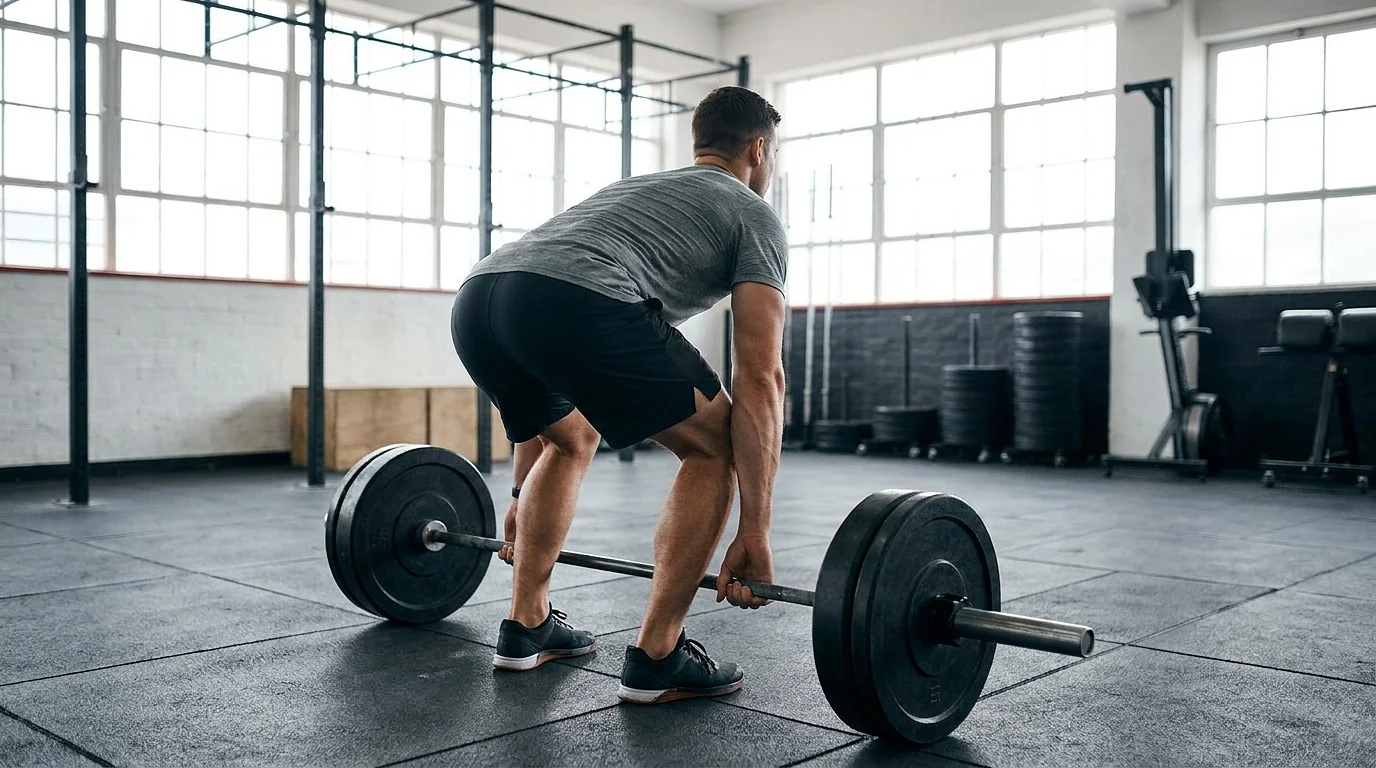
You hit a heavy pull, racked the bar, and now your lower back is stiff, tight, or lit up the next morning. Maybe it grabbed on the last rep of a top set. Maybe it crept in the day after. Either way, the question running through your head is the same one I hear in my clinic in Waukee every week: did I just hurt myself, and do I have to stop deadlifting? Lower back pain after deadlifts is one of the most common things I treat in lifters, and the good news is that most of it is manageable and most of it does not mean you are broken.
Here is the short version. The majority of deadlift back pain is a load and fatigue problem, not a damage problem. You usually do not have to stop lifting, complete rest tends to backfire, and the fix is rarely "have a perfect flat back forever." Below is how I read it, when to get it checked, and how I get lifters back under the bar.
Why does my lower back hurt after deadlifts?
Most of the time, it is your tissue telling you the demand outran its current capacity, not that something tore. The deadlift loads your low back and hips hard, and when the math gets ahead of what you are adapted to, the area gets irritated and protective.
The usual culprits I see:
-
A volume or intensity spike: you added weight, reps, or sessions faster than your body adapted.
-
Fatigue late in a set: position drifts and bracing fades on the reps that matter most.
-
A rushed setup: you pulled before you got tight, so the bar drifted away from you.
-
Coming back too hot: a few weeks off, then straight back to near your old numbers.
A 2026 narrative review on deadlift injury prevention put it plainly: the biggest drivers of low back trouble in lifters are load management, fatigue, and trunk control, not one "bad" rep (Cherni et al., 2026). In other words, it is usually the training, not the technique alone.
Is it a muscle strain or something more serious?
Most deadlift back pain is a manageable strain or joint irritation, but a short list of signs means you should get evaluated before you load it again.
Keep training, with modifications, if:
- The pain is centered in your low back, achy or stiff, and eases as you warm up and move.
- It feels sore but stable, and it is improving day to day.
Get it checked first if you have:
-
Pain, numbness, tingling, or weakness that travels down your leg, especially below the knee.
- Pain after a fall, a crash, or a true trauma.
- Pain that is severe at night or wakes you up, unexplained weight loss, or fever.
- Any change in bowel or bladder control. That one is an immediate medical visit, not a wait-and-see.
That leg-pain pattern is a different animal than a sore back, and I wrote about how I handle it in sciatica treatment. If you are not sure which bucket you are in, talk to a healthcare provider before you guess.
Not sure if yours is soreness or a problem?
That is the call I make with lifters every week, and it changes the whole plan. Tell me where it hurts and what you pulled. Send it over here.
Do I have to stop deadlifting to let it heal?
Usually no. For most mechanical low back pain, lying around and waiting it out is one of the slower ways to recover. National guidelines from the American College of Physicians recommend staying active and avoiding bed rest for acute and subacute low back pain (Qaseem et al., 2017). Your back is built to be loaded. It just needs the right dose right now.
Here is the part that surprises people: the deadlift itself can be part of the rehab. In the Journal of Strength and Conditioning Research, researchers found that deadlift training reduced pain and improved function for many people with a mechanical pattern of low back pain (Berglund et al., 2015), and a 2021 randomized controlled trial reached a similar conclusion for a deadlift-based program (Fischer et al., 2021). The bar is not the enemy. Used at the right load, it is one of the best tools I have.
Does my spine have to stay perfectly neutral?
A braced, controlled position matters, but the idea that any back rounding instantly hurts you is overstated. A systematic review with meta-analysis in the Journal of Orthopaedic and Sports Physical Therapy found no consistent relationship between lumbar spine flexion during lifting and low back pain (Saraceni et al., 2020). Trained lifters move a little, and that is normal.
So instead of chasing a picture-perfect flat back, I coach what actually moves the needle:
-
Brace before you pull. Get tight, take a breath into your belly, and set tension before the bar leaves the floor.
-
Keep the bar close. Most "my back rounded" moments are really "the bar drifted forward" moments.
-
Manage the load. Position holds up when the weight and fatigue are in a range you have earned.
Control beats rigidity. A back that can brace, move, and recover under load is a durable back.
How I get lifters back under the bar
When a lifter comes in with deadlift back pain, my first question is not "how long do we rest." It is "what can we still load." Here is what that looks like in the eval and the plan:
-
Find the real driver. Is it a volume jump, a bracing issue, stiff or weak hips, or a programming problem? The fix depends on the cause. Cranky hips are often part of the story, which I get into in hip pain in active adults.
-
Keep a version of the lift. Trap bar, block or rack pulls, tempo work, or a reduced range often let you keep loading while the irritation calms down.
-
Reload on purpose. We build the weight and range back up in steps your tissue can absorb, so it gets stronger instead of just quiet.
-
Train around it. You can usually keep most of your other training going while we work the back lift back up.
This is the same loading-first approach I use with every barbell athlete, and I broke down the full version in powerlifting physical therapy.
How do I protect my back on future deadlifts?
You make your back hard to hurt by managing the inputs, not by avoiding the lift. The lifters who stay healthy almost always do the boring things well:
-
Progress gradually. Add load and volume in small steps, and do not spike weight and reps in the same week.
-
Respect fatigue and sleep. Most "tweaks" happen on under-recovered days. A deload week is training, not weakness.
-
Build the support cast. Strong hips, hamstrings, and trunk take the tax off your low back. Loaded hinges, carries, and posterior-chain work pay off.
-
Warm up into it. Ramp your sets instead of jumping straight to a heavy single.
-
Own your setup. Same bracing and bar path every rep, especially when you are tired.
You can read more about how we approach back pain on our back pain page.
Frequently asked questions
How long does deadlift back pain take to settle?
Most simple strains calm down meaningfully within a few days to a couple of weeks when you keep moving and manage load. If it is not improving after about two weeks, or it is getting worse, get it looked at.
Should I wear a lifting belt?
A belt can help you brace and is a useful tool for heavy sets, but it does not fix a back that is hurting from too much load too soon. Use it to support good bracing, not to replace it.
Can I train other lifts while my back settles?
Usually yes. Most people keep training upper body and lower-irritation movements while we scale the deadlift. Staying active is part of the recovery.
Is it safe to deadlift with a rounded back?
A little controlled flexion is not the catastrophe it is often made out to be, especially at submaximal loads. Heavy maximal pulls with a sudden loss of position are a different story. The goal is control you can repeat, not a perfectly flat back.
When should I see a physical therapist for deadlift back pain?
If the pain is not improving after a couple of weeks, keeps coming back every training block, or comes with leg symptoms, that is the time. A good eval finds the driver so you stop chasing the same flare. That eval is where sports physical therapy starts.
The bottom line
Lower back pain after deadlifts is common, and for most lifters it is a fixable load problem, not a sign that the deadlift is bad for you. Read the warning signs, keep moving, and load the back in a range it can handle so it gets stronger instead of just going quiet. If your back keeps flaring on pulls and you want a plan built around your body and your goals, reach out through our contact page and we will get you back under the bar with confidence.
References
- Saraceni N, Kent P, Ng L, Campbell A, Straker L, O'Sullivan P. To Flex or Not to Flex? Is There a Relationship Between Lumbar Spine Flexion During Lifting and Low Back Pain? A Systematic Review With Meta-analysis. Journal of Orthopaedic and Sports Physical Therapy, 2020. https://www.jospt.org/doi/10.2519/jospt.2020.9218
- Cherni B, Marzouki H, Selmi O, Al Attar W, Chamari K, Suzuki K. Beyond the Neutral Spine: A Narrative Review and Modern Framework for Low Back Injury Prevention in Deadlifting. Sports (MDPI), 2026. https://www.mdpi.com/2075-4663/14/4/151
- Berglund L, Aasa B, Hellqvist J, Michaelson P, Aasa U. Which Patients With Low Back Pain Benefit From Deadlift Training? Journal of Strength and Conditioning Research, 2015. https://journals.lww.com/nsca-jscr/fulltext/2015/07000/which_patients_with_low_back_pain_benefit_from.6.aspx
- Fischer SC, Calley DQ, Hollman JH. Effect of an Exercise Program That Includes Deadlifts on Low Back Pain. Journal of Sport Rehabilitation, 2021. https://pubmed.ncbi.nlm.nih.gov/33626500/
- Qaseem A, Wilt TJ, McLean RM, Forciea MA. Noninvasive Treatments for Acute, Subacute, and Chronic Low Back Pain: A Clinical Practice Guideline From the American College of Physicians. Annals of Internal Medicine, 2017. https://www.acpjournals.org/doi/10.7326/M16-2367
- Low Back Pain: Clinical Practice Guidelines Linked to the International Classification of Functioning, Disability, and Health from the Orthopaedic Section of the American Physical Therapy Association. Journal of Orthopaedic and Sports Physical Therapy. https://pmc.ncbi.nlm.nih.gov/articles/PMC4893951/
This article is for general education and is not medical advice. If you are dealing with pain or an injury, consult a qualified healthcare provider for guidance specific to your situation. Individual results may vary.