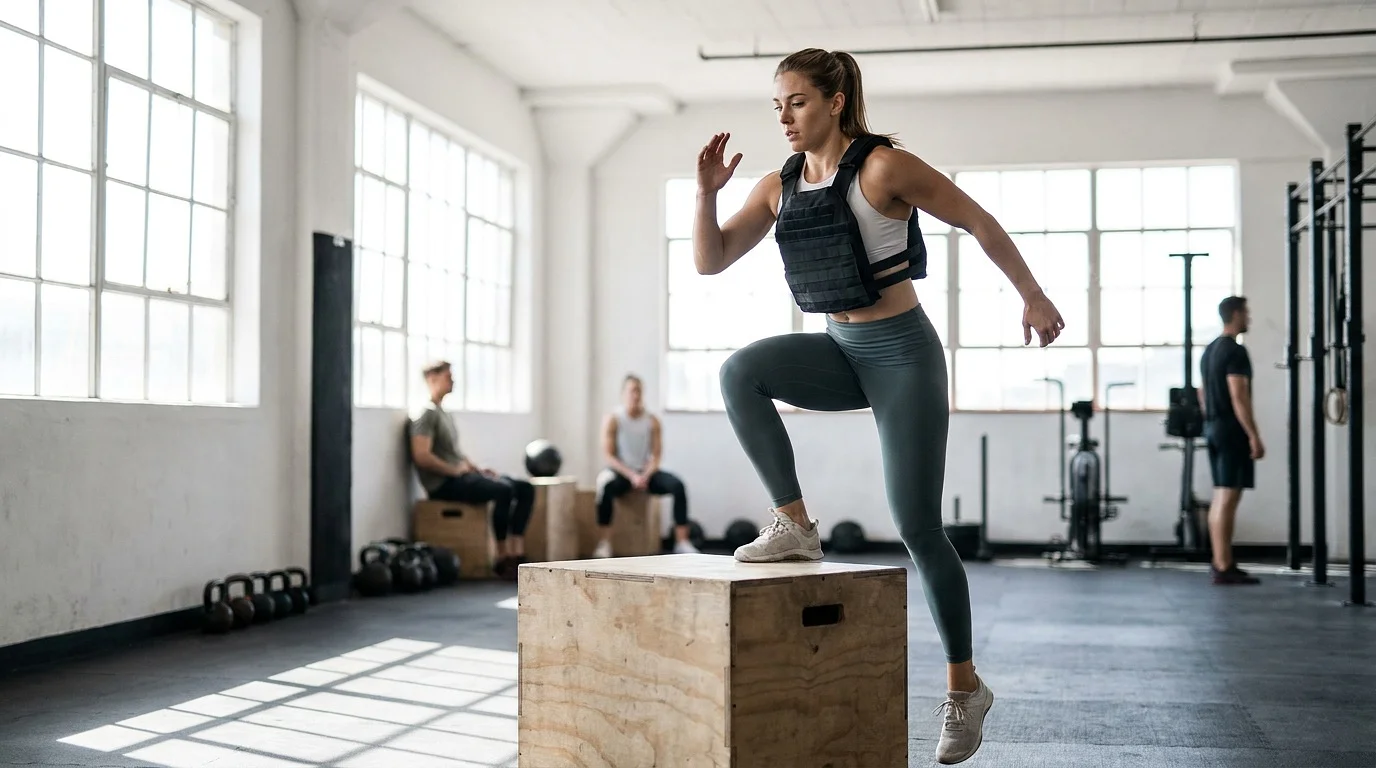
The squat that pinches in the front of your hip at the bottom. The run with a dull ache on the outside of the hip that gets sharper at mile three. The kettlebell swing that catches in the groin every rep. If any of those sound like you, you are in the right place.
Most active adults who walk into my clinic with hip pain have already done what they were told to do. They rested. They foam rolled. They stretched the hip flexors twice a day. Maybe they iced it. The pain came back the second they put a barbell on their back or laced up to run again. Here is how I think about hip pain physical therapy in my clinic, why rest usually is not the fix for active people, and how I get athletes back to training without pulling them out of the gym.
Short answer: Hip pain physical therapy for active adults finds where the pain actually comes from, whether that is the joint, the tendons on the outside of the hip, the hip flexors, or the low back, then rebuilds the hip with progressive loading, usually while you keep training. In Iowa you can start physical therapy without a physician referral. Fortitude & Freedom Performance Therapy treats hip pain in lifters and runners in Waukee, Iowa.
What Hip Pain Usually Is in Active Adults (and What It Is Not)
The first thing I do in an evaluation is figure out where the pain actually lives. About 95 percent of active-adult hip pain falls into one of three regions: anterior (front of hip and groin), lateral (outside of hip), or posterior (deep glute). Each one has its own usual suspects, and the treatment looks different depending on which one you have.
What hip pain usually is not in this population: hip osteoarthritis, avascular necrosis, or a fracture. Those exist, but they are uncommon in 30- to 50-year-old active adults without a major trauma history, and the workup looks different if I see red flags. The 2024 clinical examination algorithm for hip-related pain walks through how to rule those out and identify the actual driver [1].
Modern research has also moved past the idea that hip pain in active people is a structural-damage problem. Imaging findings like cam morphology, labral changes, or mild tendon thickening show up plenty in pain-free athletes too. The pain almost always comes from a load tolerance problem, not from a structure that needs to be fixed.
Why Rest, Stretch, and Ice Does Not Fix It
When someone walks in having taken six weeks completely off and the pain came back the moment they squatted again, I am not surprised. Six weeks of rest deconditions the exact tissue that needed to be more capable. The hip is asked to do the same job with even less capacity than before, and it predictably breaks down.
Generic hip-flexor stretching is another common culprit. If your pain is at the front of the hip and you are pulling into deep flexion (the same position that produces the pinch), you are often making an already compressed joint more compressed. Stretching can feel productive without doing anything to address why the tissue could not handle the load to begin with.
Cortisone injections look like the answer in the short term. They are not, in the long term. A 2024 systematic review and meta-analysis on gluteal tendinopathy found that exercise and corticosteroid injections produced similar pain reduction in the short term, but exercise had a treatment success rate roughly 20 percentage points higher at 52 weeks [2]. The 2024 systematic review on greater trochanteric pain syndrome in Physiotherapy reached the same conclusion: exercise is first-line care, and it beats injection over time [3].
The Three Hip Pain Patterns I See Most
Anterior hip and groin pain
Who I see this in: lifters at the bottom of the squat, kettlebell swingers, sprinters, soccer and hockey athletes, anyone doing high snatch or clean volume. Powerlifting research backs this up. Hip pain accounts for somewhere between 27 and 28 percent of injuries in powerlifters, driven by the heavy hip torque demands of the squat and deadlift [4].
Telltale signs: a pinch at the front of the hip in deep flexion, especially with internal rotation (the FADIR position). Pain with bottom-of-the-squat positions, deep lunges, or rowing strokes. Sometimes adductor pain that wraps into the groin from heavy wide-stance work.
What works: a physiotherapy program targeting the hip adductors, abductors, extensors, external rotators, and trunk. The physioFIRST trial of femoroacetabular impingement syndrome found that this targeted approach produced moderate-to-large improvements in hip pain, function, and strength [5]. For adductor-driven groin pain specifically, the Copenhagen adduction exercise has 2024 RCT evidence showing improved eccentric strength and reduced disability when programmed for 8 weeks at 1 to 3 sets of 12 to 15 reps, two or three times a week [6].
Lateral hip pain (gluteal tendinopathy and GTPS)
Who I see this in: runners stepping up mileage in the spring, hikers, side-sleepers, and women in their forties and fifties (the demographic where this is most common). Anyone whose hip hurts more lying on it at night, going up stairs, or descending hills.
Telltale signs: pain on the bony bump on the outside of the hip (the greater trochanter), worse lying on the painful side, worse on stairs, hills, or single-leg stance.
What works: progressive loading of the gluteus medius and minimus, almost exclusively. The 2024 systematic review with meta-analysis in Scientific Reports synthesized five RCTs (747 patients) and found exercise produced significantly better function at short and long term, equivalent or better than corticosteroid injection long term [2]. The protocol I use is built on that evidence. I start with hip abduction isometric at 30 degrees of abduction, side-lying, knee extended, holding 30 seconds for 6 reps daily. Then I progress to isotonic loading with a 3-second eccentric and 3-second concentric, 2 to 4 sets of 5 to 15 reps, over 12 weeks. Pain stays at or below 5 out of 10 during the work.
Posterior and deep glute pain
Who I see this in: heavy deadlifters, runners with a history of hamstring issues, anyone who sits a lot and trains hard.
Telltale signs: deep glute pain, sit-bone tenderness, sometimes a hamstring-like ache that does not quite act like a strain. Can mimic sciatica.
Why differential matters: this region overlaps with sciatic referral, lumbar referral, proximal hamstring tendinopathy, and SI joint involvement. The work I do in the eval is figuring out which one is the actual driver, because the loading plan looks different for each. I screen the SI joint with Laslett's cluster and look at lumbar contribution first when symptoms refer down the leg.
What I Actually Do in the Clinic (the F&F Hip Pain Process)
1. Find the load mismatch. Every first visit starts with a training-history audit. What changed in the last four to six weeks? More mileage. New CrossFit programming. A heavier kettlebell. Three sessions a week instead of two. A spring lifting cycle that bumped squat volume. The cause is almost always in there, and naming it is half the fix.
2. Strengthen the right muscles, not just clamshells. Generic glute med work in side-lying with no progression rarely fixes anything. I program targeted hip abduction, external rotation, hip extension, and adduction loading at intensities that actually challenge the tissue. The point is to make the hip strong enough to do what you are asking of it, not to "activate" it.
3. Loaded mobility, not stretching alone. Instead of static hip-flexor pulls, I use hip airplanes, 90/90 transitions, banded hip distractions, and deep squat sits with breathing. Mobility under load translates to the gym. Static stretching does not always.
4. Pain-guided training, not full rest. You keep the lifts and the miles you can tolerate at 3 out of 10 or below. We modify the rest. This is the same framework I use for runner's knee (see runner's knee treatment) and for any active patient I see. It works because it preserves fitness and keeps tissue loaded while we close the capacity gap.
5. Dry needling for stubborn tissue. When the TFL, glute medius, or adductor group has been guarded for so long that strengthening alone is slow to release them, I add dry needling. It is not the whole plan, it is an accelerator on the plan.
6. Progressive return to full load. The mistake I see most often is rushing back to the original training calendar the moment the pain quiets down. Pain quieting is not the same as capacity rebuilding. The same loading-based logic that drives our return-to-sport work applies here. You return to your goal training when the capacity is rebuilt, not when the pain stops.
What You Can Start Doing This Week
Before you book a visit, give self-management an honest two-week shot. Most cases of mild hip pain in active adults respond to a deliberate audit and the right loading.
Three-question audit:
Did your training load (mileage, squat volume, kettlebell weight, sessions per week) jump more than 10 percent in the last 4 weeks?
Are you stretching the painful area more than you are loading it?
Are you sleeping on the painful side?
If the answer to any of those is yes, address it before adding new exercises.
Four exercises, daily, for two weeks:
Side-lying hip abduction isometric, top leg straight, 30 degrees of abduction, hold 30 seconds, 6 reps each side
Copenhagen adduction modified (top knee on a bench, support body weight on the bottom forearm), 3 sets of 8 to 10 each side
Glute bridge with a band around the knees, 3 sets of 12, drive the knees out
Deep squat sit, 90 seconds total, focus on long calm breaths
Pain during the work should stay at or below 3 out of 10. If it climbs higher than that or lingers more than a few hours after, scale back.
When to See a Physical Therapist
Self-management gets a real shot. If any of the following are true, do not keep guessing:
Pain has been hanging on for more than two weeks of consistent self-management
Pain rises above 3 out of 10 during or after training
Pain returns immediately when you try to add load or mileage back
Pain affects daily activity, sleep, or sitting for more than 30 minutes
A race, meet, or goal event is on the calendar and the timeline matters
A first visit at Fortitude & Freedom looks like a training-history review, a movement assessment under load, and a clear plan with timelines. You leave with a program built around your sport, not a generic handout. Read more on the services page.
The Bottom Line
Hip pain in active adults is almost always a load tolerance problem, not a damage problem. Rest is not the fix because rest does not rebuild capacity. The work is loading the right muscles in the right pattern (hip abductors, external rotators, adductors, hip flexors), keeping pain at or below 3 out of 10 during training, finding the training error that started the flare, and rebuilding the way the hip handles work over weeks, not days.
If the pain has been hanging on, or you have a meet or race on the calendar you do not want to miss, book a visit at Fortitude & Freedom. 1040 SE Frontier Ave, Waukee, IA. Let's find the load mismatch and build the strength to keep you training.
References
Pavlou A, et al. A New Clinical Examination Algorithm to Prescribe Conservative Treatment in People with Hip-Related Pain. Pain and Therapy. 2024.
Effects of exercise-based interventions on gluteal tendinopathy: systematic review with meta-analysis. Scientific Reports. 2024.
Exercise compared to a control condition or other conservative treatment options in patients with Greater Trochanteric Pain Syndrome: a systematic review and meta-analysis of randomized controlled trials. Physiotherapy. 2024.
Strömbäck E, et al. Prevalence and Consequences of Injuries in Powerlifting. Orthopaedic Journal of Sports Medicine. 2018. Hip and groin injury patterns reaffirmed in the 2024 systematic review on injuries in weightlifting and powerlifting.
Kemp JL, et al. The physioFIRST Pilot Randomized Controlled Trial: targeted physiotherapy for femoroacetabular impingement syndrome. Journal of Orthopaedic and Sports Physical Therapy. 2018. Framework reaffirmed in the 2025 scoping review on conservative treatment for femoroacetabular impingement syndrome (Applied Sciences).
Alsirhani K, Muaidi Q. The effectiveness of the Copenhagen adduction exercise on improving eccentric hip adduction strength among soccer players with groin injury: a randomized controlled trial. 2024.