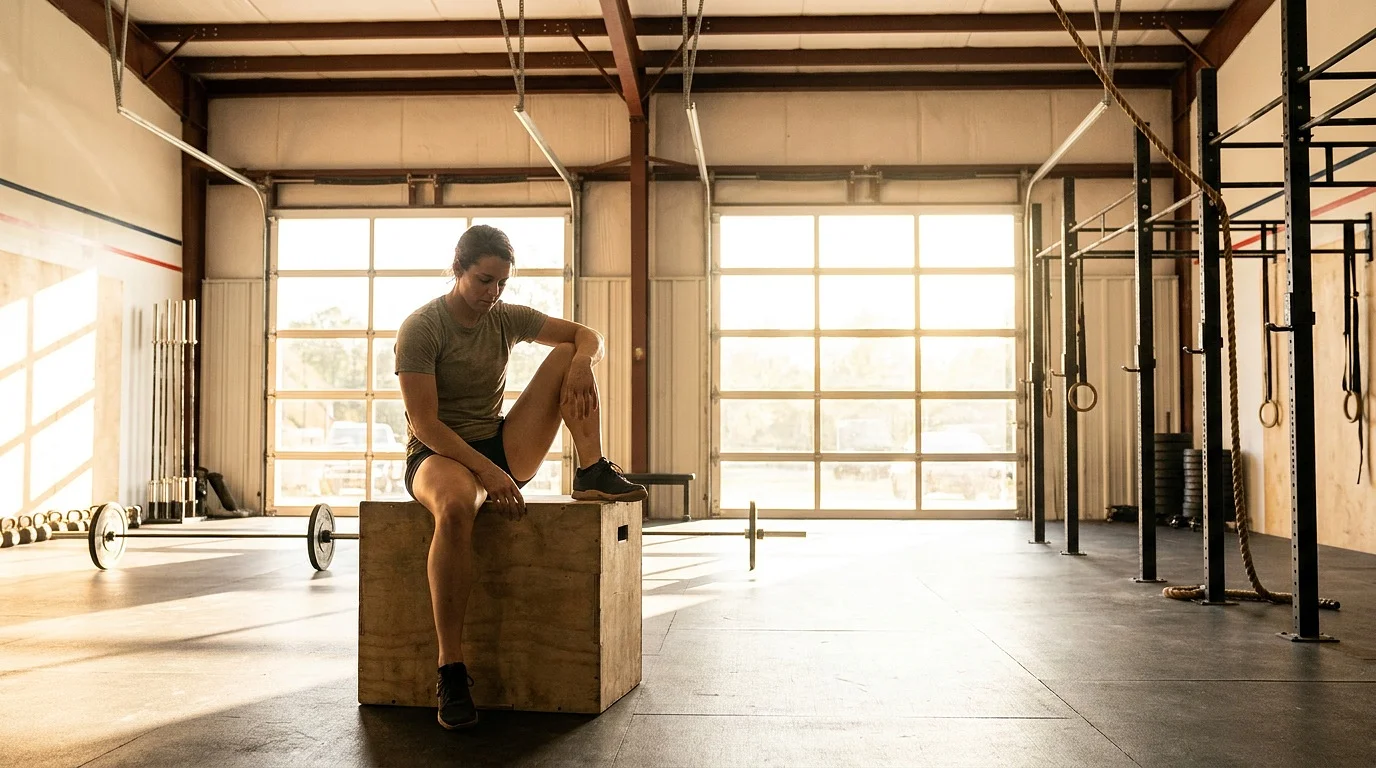
You feel it right above the kneecap on the way down into a squat, or on the landing after a box jump. Not the joint itself, not the tendon below the kneecap that everyone calls "jumper's knee," but a band of ache higher up, over the lower thigh. It warms up a few reps in, then it is there again the next morning. Most lifters call this "runner's knee" or write it off as soreness. Most of the time it is quadriceps tendonitis, and it is a different problem from the one people usually mean when they say "knee tendonitis."
Here is how to tell it apart from the tendon below the kneecap, what actually causes it in lifters, the one scenario that needs same-day attention instead of a training tweak, and what I do in the clinic to get you back to full squats and jumps.
What Is Quadriceps Tendonitis, and Why Does It Show Up Above the Kneecap?
Your quad tendon and your patellar tendon are not the same structure, even though they get lumped together constantly. The quad tendon connects your quadriceps muscle to the top of the kneecap. The patellar tendon runs from the bottom of the kneecap down to your shinbone [1]. Put a finger on the kneecap itself: above it is quad tendon territory, below it is patellar tendon territory. That one-inch distinction changes the diagnosis.
Quadriceps tendonitis, more accurately called quadriceps tendinopathy, is irritation where that upper tendon attaches. It happens when the tendon has been asked to absorb more load than it has adapted to, usually from a change in training rather than a single bad rep. The tissue is not torn. It is under-recovered and reactive, which is exactly why rest alone tends to leave it exactly where it started.
Quadriceps Tendonitis vs. Patellar Tendonitis (Jumper's Knee): How to Tell Them Apart
Both problems get called "jumper's knee" informally, but they behave differently enough that lumping them together leads to the wrong rehab plan [1]. Here is how I sort them in the clinic:
Location: Quad tendonitis is tender just above the kneecap. Patellar tendonitis is tender just below it, at the tendon that attaches to the shinbone.
Aggravating movement: Quad tendonitis flares hardest at the bottom of a deep squat and on landing from a jump, when the quad tendon is under the most stretch-load. Patellar tendonitis tends to bite more on the push-off, the top of a jump squat, or repeated jumping.
Who gets each one: Quad tendonitis shows up more in lifters doing high-volume squatting, box jumps, or a sudden jump back into plyometric work. Patellar tendinopathy is the more common of the two overall and is classically tied to jump-sport volume [2].
Population skew: Quad tendon problems, including the more serious end (rupture), trend a bit older than patellar tendon problems, which trend younger [3]. Neither rule is absolute, but it is one more clue in the exam.
If your pain sits at the front of the shin below the kneecap instead, that is patellar territory, not what this article is about. If it is on the inner or outer bony bumps of the knee, that is usually something else entirely.
What Causes It in Lifters
Quad tendinopathy is almost always a training-load story, not a one-rep injury story. The pattern I see most in the gym:
A jump in squat volume or frequency, especially high-bar or front squat work that loads the quad tendon more directly
Box jumps, broad jumps, or other plyometric work added back in after time off
A sudden increase in range of motion, like going from box squats to deep, full-range squats without a ramp-up
Weak hips or a stiff ankle, which shifts more of the deceleration job onto the front of the knee
Training through early soreness instead of adjusting volume, which turns a one-week ache into a six-week problem
If your pain is lower, at the front of the shin below the kneecap and worse specifically with squatting depth and volume rather than jump landings, knee pain from squatting covers that pattern in more depth.
How I Diagnose It in the Eval
I am not trying to guess from a description. A proper eval for suspected quad tendinopathy includes:
Palpation. Direct pressure just above the kneecap, at the tendon's attachment, reproduces the familiar ache.
Resisted knee extension. Straightening the knee against resistance, particularly near the end of the range, loads the quad tendon specifically and is one of the most reliable ways to reproduce the pain [4].
Single-leg decline squat or step-down. A slow, controlled single-leg movement into a deep bend reproduces the stretch-load pattern that bothers people in real training, and shows me how the hip and ankle are (or are not) helping share the load.
Imaging, when it is warranted. Most quad tendinopathy does not need imaging to start treatment. Ultrasound or MRI comes into play if the exam suggests a partial tear, if you are not progressing the way I would expect, or if any of the red flags below are present [4].
When It's a Tear, Not Tendonitis
This is the one place I want to be direct instead of reassuring, because a full quad tendon rupture is a real injury and it gets missed when people assume "knee pain" always means an overuse problem.
Get evaluated the same day if you have any of the following:
A pop, snap, or tearing sensation during a lift or a jump landing
Sudden, significant swelling right above the kneecap
A visible gap or dent in the tendon above the kneecap
Real inability to actively straighten the knee or hold your leg up against gravity, not just pain-limited effort
Quad tendon ruptures are uncommon, roughly 1.4 per 100,000 people per year, about twice the rate of patellar tendon ruptures, and they skew toward men over 40 [3]. The classic mechanism is a sudden, forceful eccentric load: the quad firing hard to stop you from collapsing, like catching yourself off balance or absorbing a heavy landing [3]. That is different from the gradual, training-volume story behind ordinary tendinopathy, and the two get treated completely differently. A confirmed rupture is a surgical conversation, not a loading program. If any of the signs above are on your list, that eval needs to happen this week, not after you finish testing it in the gym.
How We Treat Quadriceps Tendonitis
Once a tear is ruled out, this is a loading problem, and loading is the fix, not extended rest.
Calm it down first. Isometric holds, a straight or slightly bent knee pushed against an immovable object for five sets of 30 to 45 seconds, tend to reduce tendon pain in the short term without a full deload. I have athletes use these before a session that would otherwise flare things up.
Reduce range and volume, not the whole lift. Shallower squats, lower box jumps, or fewer total jump reps for a few weeks pulls load off the irritated range while you keep training everything else.
Rebuild with progressive loading. Structured tendon rehab, built around controlled, progressively heavier work rather than passive rest, is the approach with the strongest support across tendinopathy research broadly, including quad-specific reviews [5]. That principle holds whether the tendon in question is the quad, the patellar, or the Achilles: tendons adapt to load applied in a dose they can handle, and they do not improve much from being left alone [6].
Then reintroduce depth and jumps on purpose. The bottom of a deep squat and the landing from a jump are the positions that provoked it, so eventually they are the positions you have to retrain, deliberately and in a planned progression rather than by testing it cold on a heavy day.
Dry needling is something I use as an adjunct here, not a replacement for the loading work. When the quad is guarding hard around an irritated tendon, needling can take enough edge off that you tolerate the rehab exercises better in the same week. On injections, I will stay in my lane: that conversation belongs with your physician, and the research is clear that a loading program still needs to happen regardless of what else is done [5].
Can You Keep Training With Quadriceps Tendonitis?
Usually, yes, with modification. This is the same approach we use across the lifter tendonitis series: tendon pain is rarely a reason to stop training completely, it is a reason to train the irritated tissue differently for a while.
The rule I give athletes: pain during a set at or below a 3 out of 10, that settles within 24 hours and does not leave you stiffer the next morning, is an acceptable training dose. Anything worse than that means the volume, depth, or jump height needs to come down, not the training day itself. Upper body work, hinge patterns, and anything that does not load deep knee flexion or landing mechanics can usually continue at full intensity while the quad tendon settles.
Frequently Asked Questions
How long does quadriceps tendonitis take to heal?
Most lifters I work with notice meaningful improvement in two to four weeks with the right loading plan, and return to full-depth squats and jumping work somewhere in the six to twelve week range, depending on how long it had been building before treatment started.
Is quad tendonitis the same as a quad strain?
No. A strain is damage within the muscle belly itself, usually from a sudden, forceful contraction, and it tends to hurt more acutely and locally in the muscle. Tendonitis is irritation at the tendon's attachment above the kneecap, builds gradually, and behaves very differently in how it responds to loading.
Should I stop squatting completely?
Not usually. Full removal of squatting tends to deload the tendon faster than it can handle the return, which often makes the flare-up worse when you go back to it. Reducing depth, volume, or jump height while keeping the tendon working is generally the better path, and that is exactly the kind of call worth making in an eval rather than guessing on your own.
The Bottom Line
An ache right above the kneecap that shows up in the bottom of your squats or on jump landings is usually quadriceps tendonitis, a different problem from patellar tendonitis and a loading problem with a loading solution. Rule out the red flags above first. Then the fix is reducing range and volume just enough to calm it down, rebuilding tendon capacity on purpose, and getting back to full depth and jumping instead of avoiding them indefinitely.
If you train in Waukee, West Des Moines, or anywhere in the Des Moines metro and that ache above your kneecap has been sticking around, reach out through our contact form and we will figure out exactly which tendon is involved and build the plan around keeping you training, not around sitting out. That plan is built through sports physical therapy at the Waukee clinic.
References
Rio E, Moseley L, Purdam C, et al. Distinguishing Quadriceps Tendinopathy and Patellar Tendinopathy: Semantics or Significant? Journal of Orthopaedic & Sports Physical Therapy. 2019;49(9):627-630. https://www.jospt.org/doi/10.2519/jospt.2019.0611
Mayo Clinic Sports Medicine. Patellar Tendinitis and Kneecap Instability. https://sportsmedicine.mayoclinic.org/condition/kneecap-instability-patellar-tendinitis/
Baker N, Varacallo M. Quadriceps Tendon Rupture. StatPearls. National Center for Biotechnology Information. https://www.ncbi.nlm.nih.gov/books/NBK482389/
Meredith SJ, et al. Diagnosis and Management of Common Tendinopathies. Current Reviews in Musculoskeletal Medicine. 2025. https://pmc.ncbi.nlm.nih.gov/articles/PMC12446175/
King D, Yakubek G, Chughtai M, et al. Quadriceps tendinopathy: a review, part 2, classification, prognosis, and treatment. Annals of Translational Medicine. 2019;7(4):61. https://atm.amegroups.org/article/view/23948/html
Beyer R, Kongsgaard M, Hougs Kjær B, et al. Heavy Slow Resistance Versus Eccentric Training as Treatment for Achilles Tendinopathy. American Journal of Sports Medicine. 2015;43(7):1704-1711. https://pubmed.ncbi.nlm.nih.gov/26018970/
This article is for informational purposes and is not a substitute for professional medical advice. Individual results vary. If you have pain above your kneecap, especially with swelling, a visible gap, or an inability to straighten your leg, consult a qualified healthcare provider before continuing to train through it.