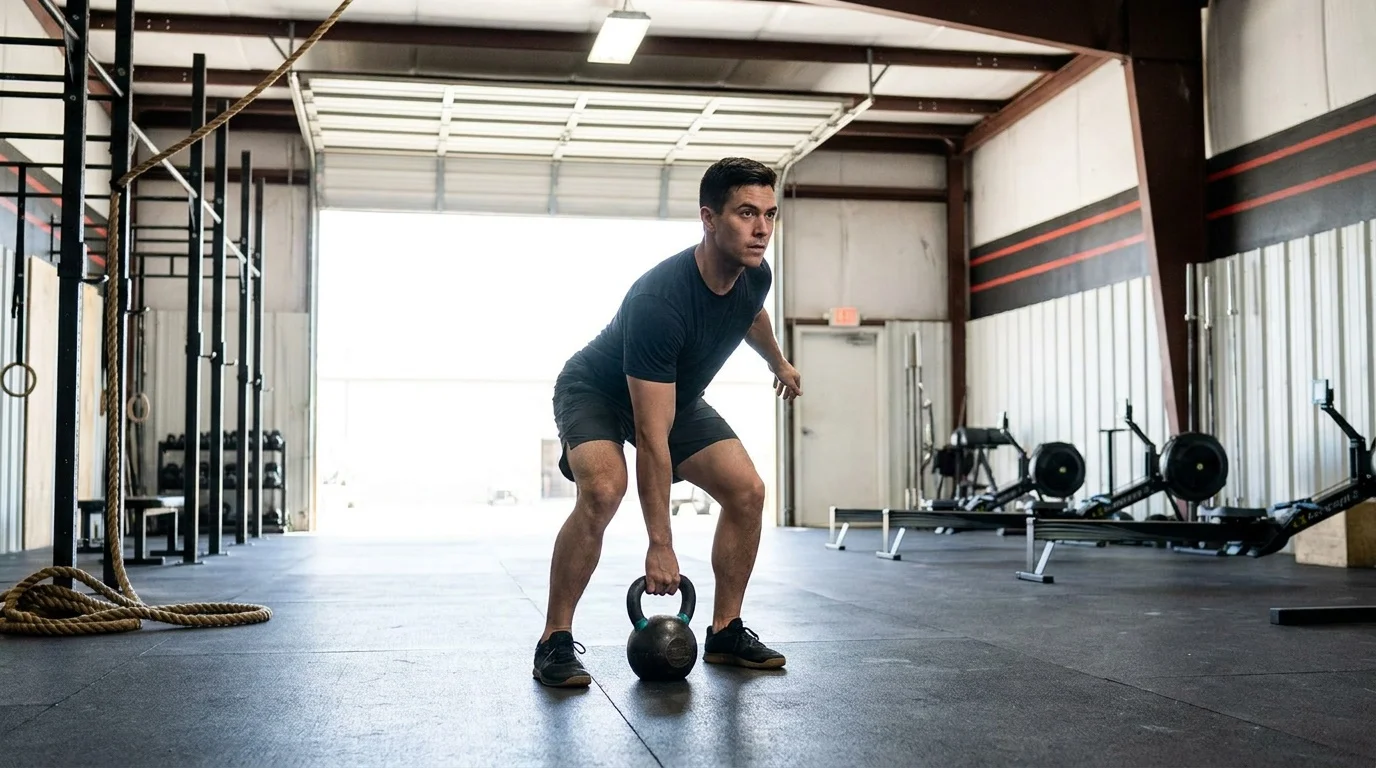
You pulled heavy on Monday. Tuesday morning you get out of bed, your low back is stiff and achy, and now you are doing math on whether Thursday's session is still happening. Somewhere in the back of your mind there is also a quieter question: did I actually do something to my back?
I get asked about a sore lower back after deadlifts more than almost anything else. Active people want a straight answer, so here is mine. Most of the time, that soreness is your back doing exactly what you asked it to do. It is muscle soreness, not damage. But not always, and the difference is worth knowing how to spot.
So this is the criteria I actually use in the clinic. Where soreness should sit, how long it should last, what makes me look closer, and how I load the following week either way.
The short answer: a sore lower back after deadlifts is usually normal
Soreness that is broad, sits on both sides of your spine, shows up the morning after, and loosens as you warm up is almost always normal muscle soreness.
Pain that is sharp, stays on one side, is there while you are lying still, travels down your leg, or gets worse on day three instead of better is a different conversation. That one is worth a look.
Most lifters land squarely in the first group. Here is how to tell which one you are in.
What normal deadlift soreness feels like
Where you feel it
Normal soreness is broad and hard to pin down. Ask someone with typical deadlift soreness where it hurts and they rub a whole area with an open hand, usually the muscle running up either side of the spine, and often the glutes and hamstrings too. It sits on both sides, roughly evenly.
Soreness you can cover with one fingertip, on one side only, is the version worth paying attention to.
When it shows up and how long it lasts
Delayed onset muscle soreness runs on a predictable clock. You typically feel nothing for the first eight hours or so, it peaks one to two days after the session, and it settles within seven days [1].
In practice: sore Tuesday morning after a Monday pull, worst Tuesday night or Wednesday, noticeably better by the weekend. That is a normal pattern and it does not need fixing.
Pain that arrives during the set, or the moment the bar hits the floor, is not this. Different timeline, different conversation.
What it does when you move
This is the most useful test you can run on yourself, and it costs nothing.
Normal soreness feels worst when you first get moving and better once you are warm. Walk for ten minutes, do some easy hinging, and typical soreness fades into background noise. If ten minutes of easy movement makes it worse instead of better, that is a real signal.
What it feels like when it is not just soreness
|
Normal soreness |
Worth getting checked |
| Where it sits |
Broad, both sides, open-hand area |
Sharp, one side, you can point to it |
| When it starts |
Next morning, not during the set |
During the lift or right after |
| Response to warm-up |
Eases as you get moving |
Same or worse after ten minutes |
| Days 3 to 4 |
Clearly improving |
Holding steady or getting worse |
| Leg symptoms |
None |
Numbness, tingling, or pain past the knee |
One entry in the right-hand column does not mean something is wrong. It means you have a question worth answering instead of guessing at for another six weeks.
If leg symptoms are the row you landed on, Sciatica Treatment: Stop Resting, Start Loading covers what that usually is and what actually moves it. And if you are past soreness and into pain that keeps returning, Lower Back Pain After Deadlifts (and How to Keep Lifting) is the deeper piece on managing it without leaving the gym.
When you should get it looked at right away
Most back soreness is harmless. A small number of symptoms are not, and they are worth knowing so you never sit on one. Get medical care promptly if any of these show up alongside back pain [5]:
- Numbness in the area that would touch a saddle: inner thighs, groin, or buttocks
- New trouble controlling your bladder or bowels
- New weakness in both legs
- Back pain that follows a significant fall, crash, or other major trauma
- Fever along with the back pain
- Unexplained weight loss, or night pain that keeps worsening instead of easing
None of these are common in a healthy lifter who just pulled a heavy triple. They are on the list because they are the ones you do not want to wait out.
Why your back gets sore after deadlifts in the first place
A deadlift asks the muscles along your spine to hold a position under load while your hips and legs do the moving. Hold that long enough and heavy enough, and those muscles get worked in a way most other training does not replicate. Add the lowering half of the lift and you have a recipe for classic muscle soreness.
Here is the part most lifters have never been told, and it is good news. Muscle adapts to that specific stress quickly. One hard bout protects you against soreness from the next one, and that protective effect has been measured lasting as long as 24 weeks between sessions [2].
It is why the first heavy deadlift day back after a layoff flattens you and the second one barely registers. Your back is not fragile. It is under-exposed. The answer to under-exposed is exposure, managed well.
Does soreness mean your form is broken?
Not on its own, no.
Technique is the first place lifters go, and it is usually not where the answer is. When researchers compared physically active adults who had low back pain against healthy controls during deadlifts, they found no significant differences in how the muscles shared the load [3]. The lifters with back pain were not moving differently.
In my clinic, three things explain most sore-back deadlift sessions, and none of them is your setup:
- The jump was too big. You added 20 or 30 pounds because last session felt easy.
- Volume crept up close to failure. Five grinding sets instead of three clean ones.
- Something was new. Deficit pulls, stiff-leg, RDLs, a different bar, or simply your first heavy day in a month. New stimulus, predictable soreness.
When technique genuinely needs work, you usually know it, because the lift feels inconsistent from rep to rep. Not because you woke up sore.
What I do the week after a sore-back deadlift session
The instinct is to shut it down and wait. That is the one I would talk you out of. When researchers surveyed injured powerlifters, 81% adjusted their training to keep going and only 16% had to stop training altogether [4]. Modifying beats stopping, and modifying is what I coach.
Here is the week:
- Days 1 and 2: keep moving, drop the load. Walk. Easy bodyweight hinges and hip work. You are not resting, you are lowering the dose.
- Day 2 or 3: hinge light. Kettlebell RDLs or a light trap bar pull, somewhere around 40 to 50 percent of what made you sore, for smooth reps that stop well short of hard. Movement is what makes soreness feel better, and the pattern stays grooved.
- Days 4 and 5: train everything else normally. Press, squat, carry, condition. Sore erectors are not a reason to write off your whole week.
- Next deadlift day: repeat the same weight. Do not chase the jump that made you sore. Hit the same load and let that protective adaptation do its job. It will feel dramatically better.
- Then build in smaller steps. Five to ten pounds, or one extra rep. Boring progression is the progression that sticks.
If you are working around back soreness regularly and you want your strength numbers to keep climbing anyway, Powerlifting Physical Therapy: What Barbell Athletes Need covers how we structure that.
When the soreness comes back every single session
Here is the pattern that actually gets my attention: you are sore in the same spot after every deadlift day, at every weight, and it never gets easier.
That is not adaptation. Adaptation gets quieter over time. Soreness that never quiets down usually means one of a few things. You are progressing faster than you recover. You are pushing nearly every set to failure. Or something in how you are loading is asking one area to do a job it cannot keep doing on repeat.
Far more often than not, that is a programming problem rather than a tissue problem, and it is a quick conversation with someone who can watch you lift. For some people, hands-on work speeds things along next to the loading. Dry Needling for Back Pain covers where that fits and where it does not.
The bottom line
Sore is usually fine. Broad, both sides, better once you are warm, gone by the weekend: that is your back adapting, and the fix is a smaller jump next time, not a month off. Sharp, one-sided, worse on day three, or running down your leg: get eyes on it instead of guessing through another six weeks of working around it.
If your back has been the thing capping your deadlift, I would rather look at it than watch you keep training around it. You can see how I work with lifters under sports physical therapy. Reach out through the contact form and let's get you pulling again.
References
- Sonkodi B, Berkes I, Koltai E. Have We Looked in the Wrong Direction for More Than 100 Years? Delayed Onset Muscle Soreness Is, in Fact, Neural Microdamage Rather Than Muscle Damage. Antioxidants. 2020;9(3):212. https://doi.org/10.3390/antiox9030212
- Connolly DAJ, Reed BV, McHugh MP. The Repeated Bout Effect: Does Evidence for a Crossover Effect Exist? Journal of Sports Science and Medicine. 2002;1(3):80-86. https://pmc.ncbi.nlm.nih.gov/articles/PMC3967433/
- McGowen JM, Albin SR, Hoppes CW, Forsse JS, Abt J, Koppenhaver SL. Physically Active Adults With Low Back Pain Do Not Demonstrate Altered Deadlift Mechanics: A Novel Application of Myotonometry to Estimate Inter-Muscular Load Sharing. International Journal of Sports Physical Therapy. 2024;19(1):1462-1472. https://doi.org/10.26603/001c.90707
- Strömbäck E, Aasa U, Gilenstam K, Berglund L. Prevalence and Consequences of Injuries in Powerlifting: A Cross-sectional Study. Orthopaedic Journal of Sports Medicine. 2018;6(5):2325967118771016. https://doi.org/10.1177/2325967118771016
- Margetis K, Singh C, Casiano VE, Varacallo MA. Low Back Pain: Evaluation and Management. In: StatPearls. Treasure Island (FL): StatPearls Publishing; 2026. https://www.ncbi.nlm.nih.gov/books/NBK538173/
This article is for general education and is not medical advice. It cannot account for your specific situation. Talk with a healthcare provider about your own symptoms, and seek care promptly if you have any of the warning signs listed above. Individual results may vary.