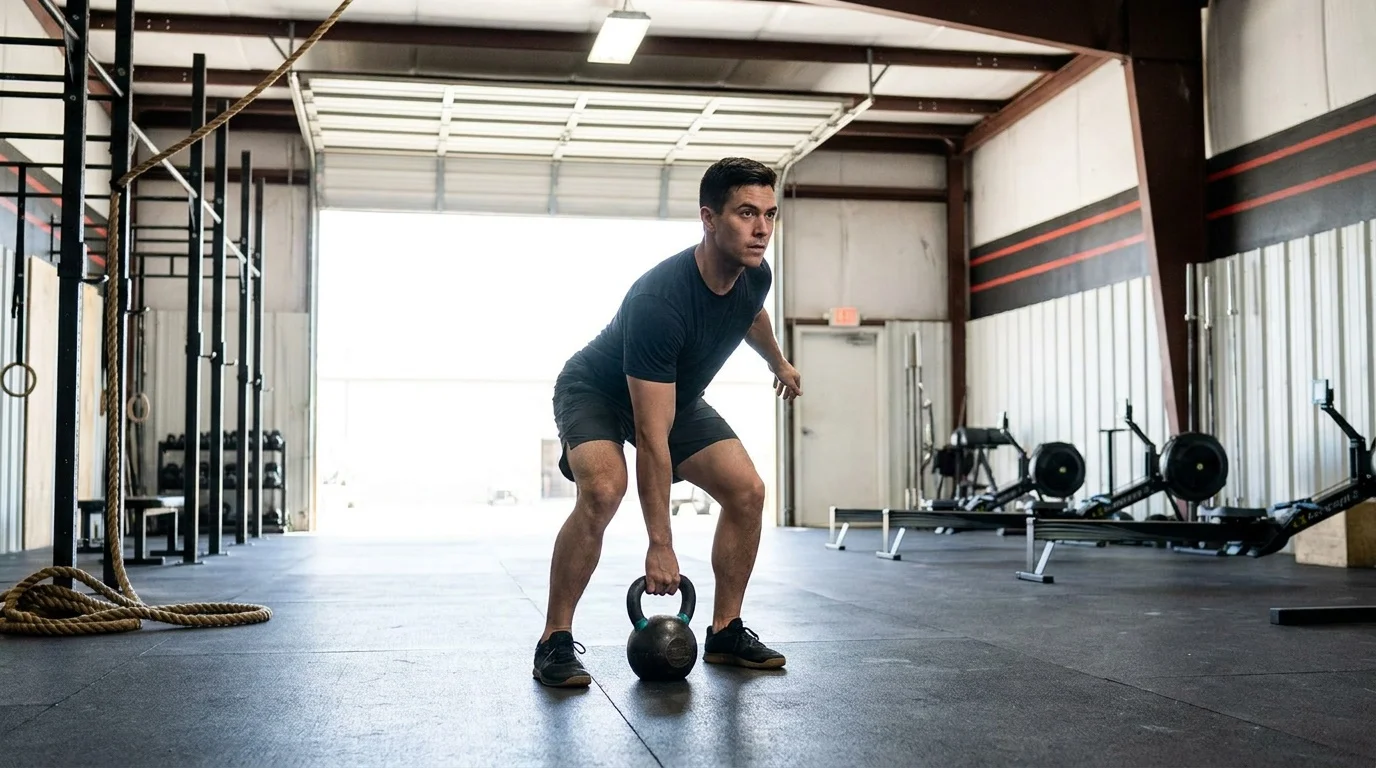
You felt it on the last rep. Maybe a sharp grab low in your back as the bar left the floor, maybe a slow tightening that got worse on the drive home. Now you are standing up carefully, and the only question on your mind is how long deadlift back injury recovery is going to take.
Here is the good news up front: most deadlift back injuries recover a lot faster than they feel like they will. The biggest change usually happens in the first six weeks, and you do not have to stop training to get there. In this article I will walk you through a realistic deadlift back injury recovery timeline, week by week, including what to train at each stage, how to bring the hinge back, and the signs that mean you should get it checked instead of waiting it out.
How long does a deadlift back injury take to heal?
For most lifters, a tweaked lower back from a deadlift improves a lot within 2 to 6 weeks. A 2024 meta-analysis of people with acute low back pain found that average pain dropped from 56 to 26 out of 100 within the first six weeks, and disability dropped by about half in the same window [1]. Around 90% of acute low back pain resolves or improves significantly within the first 30 days [2].
That is the typical course for a muscle or soft tissue strain. It is not a promise for every back. Pain that runs down your leg, numbness, or weakness is a different situation, and I cover the warning signs further down.
Is it an injury or just soreness?
Soreness shows up a day or two after a hard session, feels like a broad, dull ache on both sides of your spine, and loosens up as you move. An injury usually shows up during the lift or within a few hours, is sharper or more one-sided, and gets angry with specific movements like bending to tie your shoes or getting out of the car.
If what you feel sounds more like the first description, read Is It Normal for Your Lower Back to Be Sore After Deadlifts? instead. If you want the full breakdown of why deadlifts irritate the back in the first place, that lives in Lower Back Pain After Deadlifts (and How to Keep Lifting). This article is about the timeline: what happens after you have already tweaked it.
Your deadlift back injury recovery timeline at a glance
This is the timeline I use as a starting point with lifters. Your back sets the pace, not the calendar, so treat these as typical ranges.
| Stage |
What you usually feel |
What you train |
The deadlift |
| Days 0 to 3 |
Sharp with certain movements, stiff in the morning |
Walking, easy movement, upper body |
Off |
| Days 4 to 14 |
Pain easing, bending still cautious |
Most upper body, single-leg work, light hinge drills |
Pain-free patterns only (hip hinge with a dowel, light RDL) |
| Weeks 2 to 6 |
Mostly normal day to day, some awareness under load |
Near-normal training with the hinge scaled |
Build back: RDL, kettlebell deadlift, block pulls |
| Weeks 6 to 12 |
Normal day to day |
Full program |
Back from the floor, working up toward previous loads |
| Past 12 weeks |
Still limited or flaring |
Get it assessed |
Plan built around what the assessment finds |
Days 1 to 3: move, do not lie down
The first instinct after a back tweak is to lie still and wait. The evidence points the other way. A Cochrane review found that people with acute low back pain who were advised to stay active had slightly better pain relief and function than people advised to rest in bed [3]. Bed rest longer than a day or two is not recommended [2].
What that looks like in practice:
- Walk. Short, frequent walks beat one long one. If 10 minutes feels good, do it three times a day.
- Find the positions that calm it down. For some lifters that is lying on your back with your knees bent. For others it is standing and walking. Use whatever settles the pain.
- Train what does not hurt. Upper body machines, seated presses, and arm work are usually fine. If a movement spikes the pain, skip it for now.
- Skip the stretch-it-out urge. Aggressive toe-touch stretches rarely help a freshly irritated back. Gentle movement does more.
Weeks 1 to 2: train around it
By the end of the first week, most lifters notice the sharp edges softening. This is where you start rebuilding confidence without testing the injury.
I use a simple rule: pain during an exercise is acceptable if it stays at or below a 3 out of 10 and settles back to where it started by the next morning. If it is worse the next day, the dose was too much, not the exercise.
Good options in this stage:
- Single-leg work: split squats, step-ups, and single-leg RDLs to a box, held light.
- Carries and bracing: suitcase carries and farmer carries teach your trunk to stiffen without a big spinal load.
- Hinge practice: a hip hinge with a dowel along your back, then a light RDL through the range that feels good.
- Conditioning: bike, sled pushes, or incline walking to keep your engine running.
Weeks 2 to 6: bring the hinge back
This is the stage where people either rebuild the deadlift or rush it and end up back at square one. The goal is to expose your back to hinge loading again, in steps small enough that it keeps getting better.
My usual progression:
- Romanian deadlift with a light barbell or dumbbells, through a pain-free range, 3 sets of 8 to 10.
- Kettlebell deadlift from a block or plates, so you do not have to reach all the way to the floor.
- Block pulls or rack pulls from just below the knee, building load over one to two weeks.
- Lower the block in stages until you are pulling from the floor again.
Move to the next step when the current one feels easy for two sessions in a row and your back is no worse the next morning. Add load in small jumps, around 5 to 10% a week, rather than trying to find your old working weight in one day.
How do you know you are ready to pull heavy again?
You are usually ready to work back toward heavy deadlifts when you can check every box here:
- Day-to-day life is pain-free: sitting, driving, sleeping, putting on socks.
- You can hinge with an empty bar, from the floor, without guarding or bracing like it might hurt.
- Your working sets at about 70% of your previous load feel normal and leave no flare the next day.
- You trust the lift. Hesitation on the way down often means your back is not the only thing that needs rebuilding.
If you check those boxes, keep building. If one of them keeps failing week after week, that is useful information and a good reason to get it looked at.
Why does my back keep getting hurt when I deadlift?
A back tweak is common among lifters and it does not mean you are fragile. In a survey of subelite powerlifters, 70% were dealing with an injury at the time, and the lumbopelvic region was one of the most common areas. Only 16% of those currently injured had to stop training completely [4].
The catch is that backs that have been hurt once tend to get hurt again. In the best available cohort, about 33% of people had a new episode of low back pain within a year of recovering, and a history of previous episodes was the one factor that consistently predicted it [5].
In my experience, repeat tweaks usually trace back to a few things:
- Load jumps: coming back to your old numbers too fast after the pain fades.
- Fatigue: heavy pulls at the end of a long session, or high volume on low sleep.
- A gap in capacity: strong enough to pull the weight when fresh, not strong enough to own it on rep 8.
- Skipping the rebuild: stopping the progression the week the pain disappears.
The fix is not avoiding the deadlift forever. It is building the back's capacity past the loads you plan to lift.
When should you get a deadlift back injury checked?
Most deadlift back injuries are strains that settle with smart loading. Some are not. Get checked promptly if you notice any of these [2]:
- Numbness in your groin or inner thighs (saddle area)
- New trouble controlling your bladder or bowels
- Weakness in a leg or foot that is getting worse
- Pain that is worse lying down and came on without a clear cause
- A history of cancer or long-term steroid use
Bladder, bowel, or saddle numbness changes are an emergency. Go to the emergency room.
Beyond the red flags, book an assessment if the pain is not clearly improving after two weeks, if it keeps coming back every training block, or if it travels below your knee. Leg symptoms often point to an irritated nerve, and sciatica treatment works differently than a simple muscle strain.
How I get lifters back under the bar
When a lifter comes in with a deadlift back injury, the first thing I do is figure out what is actually irritated and which movements set it off. Then I build the plan backward from what you want to lift, not forward from a generic protocol.
That usually means three things. First, we keep you training: the goal is to change the program, not to cancel it. Second, we load the back on purpose, with the hinge progression above adjusted to your body and your numbers. Third, we look at the program that led to the injury, because the load jump or the fatigue pattern is often the real cause.
Sometimes I add hands-on treatment to calm things down faster, like dry needling for back pain. It is a tool to help you train, not a substitute for loading. If you want to see how I think about training around injuries more broadly, physical therapy for lifters covers it, and the sports physical therapy page explains how a visit works.
Frequently asked questions
Should I stop lifting completely after hurting my back deadlifting?
Usually not. Most lifters do better when they keep training the movements that do not hurt and scale the deadlift back temporarily. Complete rest tends to leave you deconditioned and less confident when you return.
How long should I wait before deadlifting again after a back injury?
Many lifters can start light hinge work within 1 to 2 weeks and are pulling from the floor again within 4 to 6 weeks. Base it on the readiness checklist above, not on a fixed date.
Is it a disc injury or a muscle strain?
You cannot tell for sure on your own. Pain that stays in the back and eases with movement is more consistent with a strain. Pain, numbness, or tingling that travels down the leg deserves an assessment.
Can I use a belt when I come back?
Yes. A belt can help you brace, and many lifters like it during the return. It is not a replacement for building capacity, so keep the progression gradual either way.
The bottom line
A deadlift back injury feels like a big deal on day one, but most lifters improve a lot within six weeks. Keep moving in the first few days, train around the pain in the first two weeks, and rebuild the hinge in small steps before you chase your old numbers. Watch for the red flags, and get it assessed if it stalls, keeps coming back, or runs down your leg.
If your back is not bouncing back and you want a plan that keeps you training, book a free discovery call and let's get you back to pulling with confidence.
References
- Wallwork SB, Braithwaite FA, O'Keeffe M, et al. The clinical course of acute, subacute and persistent low back pain: a systematic review and meta-analysis. CMAJ. 2024;196(2):E29-E46. https://doi.org/10.1503/cmaj.230542
- Marulli A, Patel T, Gourneni S. Lumbar Strain. PM&R KnowledgeNow. American Academy of Physical Medicine and Rehabilitation. Updated June 5, 2025. https://now.aapmr.org/lumbar-strain/
- Dahm KT, Brurberg KG, Jamtvedt G, Hagen KB. Advice to rest in bed versus advice to stay active for acute low-back pain and sciatica. Cochrane Database of Systematic Reviews. 2010;(6):CD007612. https://doi.org/10.1002/14651858.CD007612.pub2
- Strömbäck E, Aasa U, Gilenstam K, Berglund L. Prevalence and consequences of injuries in powerlifting: a cross-sectional study. Orthopaedic Journal of Sports Medicine. 2018;6(5):2325967118771016. https://doi.org/10.1177/2325967118771016
- da Silva T, Mills K, Brown BT, Herbert RD, Maher CG, Hancock MJ. Risk of recurrence of low back pain: a systematic review. Journal of Orthopaedic & Sports Physical Therapy. 2017;47(5):305-313. https://doi.org/10.2519/jospt.2017.7415
Medical disclaimer: This article is for educational purposes and is not personal medical advice. Consult a healthcare provider about your specific situation. Individual results may vary.