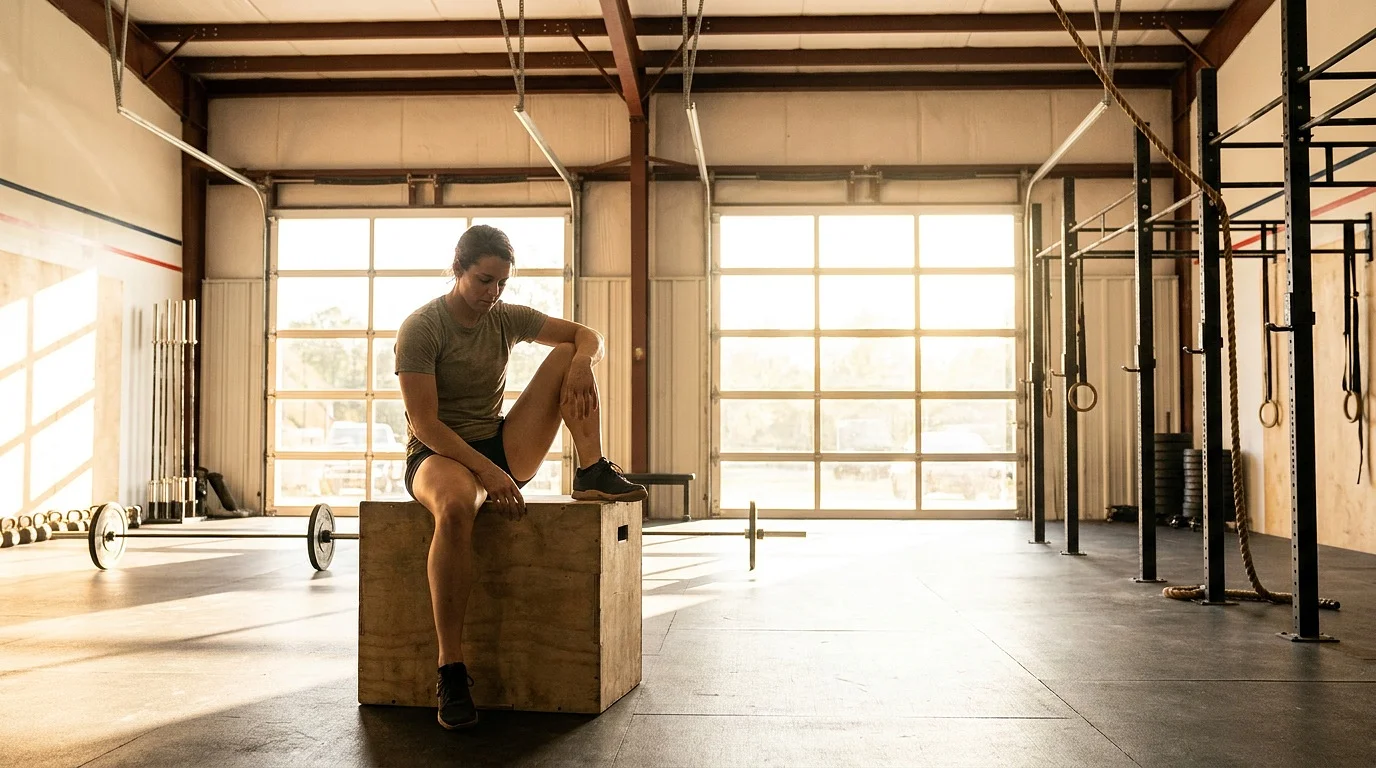
You tweaked something two weeks ago. Maybe it was the last rep of a heavy set, maybe it just showed up on a run. You've kept training around it, and it hasn't gotten worse. It also hasn't gone away, and you're starting to wonder if you should see a physical therapist.
That's the question every athlete runs into at some point: is this normal soreness, or is it time to get it looked at?
I get asked that constantly, and there's a real answer. In this article I'll give you the rule I use to tell soreness from injury, the signs that mean it's time to see a physical therapist, the few red flags that mean see a doctor first, and what to do about it if you train anywhere around Waukee.
The short answer
See a physical therapist when pain lasts more than a few days, gets worse from one week to the next, or changes how you move. Normal training soreness peaks within about three days and fades on its own [1]. Pain that sticks around, climbs, or makes you avoid a movement is your body telling you the load and the tissue aren't matched anymore, and that's exactly the problem a physical therapist is trained to solve.
Soreness or injury: how to tell the difference
Soreness after hard training is expected. Delayed onset muscle soreness usually shows up 8 to 24 hours after a session and peaks somewhere between 24 and 72 hours [1]. It's the price of a new stimulus, and it's not a reason to worry.
An injury behaves differently. Here's how I explain the difference to athletes:
|
Normal training soreness |
Signs of an injury |
| Where |
Spread across the muscle you trained |
One specific spot you can point to |
| When |
Starts the next day, peaks by day 2 or 3 |
Starts during the lift or run, or lasts past a week |
| Feel |
Dull, achy, stiff |
Sharp, pinching, or catching |
| With warm-up |
Gets better as you move |
Stays the same or gets worse |
| Effect on training |
You can still move well |
You change the lift to avoid it |
If you've ever wondered about this after a heavy pull, I broke down the deadlift version in is it normal for your lower back to be sore after deadlifts.
The 0-10 rule I use to decide if you can keep training
Pain isn't automatically a stop sign. Some pain during rehab and training is acceptable, as long as it behaves.
The model I use comes from research on athletes with Achilles tendon pain. In that randomized study, one group kept running and jumping while following a pain-monitoring rule, and the other group stopped those activities for six weeks. Both groups improved, and the group that kept training did just as well [2].
Here's the rule, the way I tell every athlete who walks in:
- During training, pain up to 5 out of 10 is okay.
- By the next morning, it should settle back to where it was before.
- From week to week, it should not be climbing.
If all three hold, keep training and keep an eye on it. If any one of them breaks, the load is ahead of what the tissue can handle right now. That's your cue to adjust, and if adjusting on your own isn't working, it's your cue to get help.
6 signs it's time to see a physical therapist
If any of these sound familiar, don't wait for it to fix itself:
-
The pain doesn't settle by the next morning. You're sorer the day after than you were before the session.
-
It's climbing week to week. Same training, more pain.
-
You're working around it. You've narrowed your grip, cut your depth, dropped the weight, or skipped a movement to avoid it.
-
It's one sharp spot with one lift. Pain that shows up in the same place with the same movement every time is specific, and specific problems have specific fixes.
-
The joint swells, gives way, or catches. A knee that buckles or a shoulder that clicks with pain needs a real look.
-
It's been two weeks or more. If it hasn't meaningfully improved in two weeks of smart training, time alone probably isn't the answer.
None of these mean you have to stop training. They mean you need a plan that fits what's actually going on.
Red flags: see a doctor first
A few symptoms are not a physical therapy problem to start with. If you have any of these, see a physician or go to urgent care first:
- Numbness, tingling, or weakness that is spreading or getting worse
- Pain at night that doesn't change no matter how you position yourself
- Fever, chills, or unexplained weight loss along with the pain
- A visible deformity, or you can't put weight on the limb after a fall or impact
- New changes in bowel or bladder control
Part of my job in every evaluation is screening for exactly these things. If something needs a physician or imaging, I'll tell you that and help you get there.
Why waiting usually costs you more training
The instinct to push through makes sense. Athletes are good at tolerating discomfort, and that's part of what makes them athletes.
The trouble is how common these nagging problems are. In a study that tracked Olympic and Paralympic athletes every week for 40 weeks, 36% of athletes had a health problem at any given time, and overuse injuries made up 49% of the total burden, more than illness or acute injuries [3]. Fewer than half of those athletes had a problem big enough to cut their training or performance. The rest were training through it.
Load is the other half of the story. The International Olympic Committee's consensus on training load found that rapid increases in load are a major risk factor for injury [4]. That's what a training block, a meet prep, or a race build does by design. It's also why events like HYROX, which stack load on top of fatigue, produce the same injury patterns again and again. I covered those in HYROX injuries: the 5 stations that hurt people.
Catching a problem at the "annoying" stage almost always means fewer changes to your training than catching it at the "I can't lift" stage.
Do you need a referral in Iowa?
No. Iowa has allowed people to see a physical therapist directly, without a physician referral, since 1988 [5]. You can book an evaluation the day you decide you want answers.
If you want the longer version, I wrote about it in what orthopedic physical therapy actually is (and when you don't need a referral).
What happens when you come in
The first visit is a full hour, one on one. I start with your training history and what the pain does, then test you in the movements your sport asks for. A lifter gets tested under a barbell. A runner gets tested at running loads. You start treatment the same day, and in most cases you keep training with a few specific changes.
I walk through the whole hour in your first visit: how I evaluate an athlete on day one. And if you want to see how we build rehab around lifters, runners, CrossFit, and HYROX athletes, here's how our physical therapy for athletes in Waukee works.
Common questions
Should I rest until it stops hurting?
Usually not. Complete rest takes load off the tissue, but it also takes away the stimulus the tissue needs to get stronger, so the pain often comes right back when you return. Modified training with a pain-monitoring rule has held up well in the research [2]. Rest has its place for some acute injuries, which is one of the things an evaluation sorts out.
Can I keep lifting while I rehab?
In most cases, yes. The goal is to find the version of each lift you can load without flaring things up, then build back toward the full movement. That might mean a different bar position, a tempo, a range of motion, or a lighter day while we work.
How long should I wait before I book?
If your pain fails the 0-10 rule, or hits any of the six signs above, there's no reason to wait longer. If it's been two weeks without real progress, that's the latest point I'd suggest. Earlier is almost always easier.
The bottom line
Soreness peaks in a few days and fades. Pain that doesn't settle by morning, climbs week to week, or changes how you move is worth getting looked at, and the sooner you do, the less your training has to change.
Use the 0-10 rule, watch for the six signs, and see a doctor first for the red flags. You don't need a referral in Iowa, and you don't need to wait until you can't train.
If something has been nagging you, reach out and book an evaluation. Let's get you back to training without guessing.
References
- Cheung K, Hume P, Maxwell L. Delayed onset muscle soreness: treatment strategies and performance factors. Sports Medicine. 2003;33(2):145-164. https://pubmed.ncbi.nlm.nih.gov/12617692/
- Silbernagel KG, Thomeé R, Eriksson BI, Karlsson J. Continued sports activity, using a pain-monitoring model, during rehabilitation in patients with Achilles tendinopathy: a randomized controlled study. American Journal of Sports Medicine. 2007;35(6):897-906. https://journals.sagepub.com/doi/abs/10.1177/0363546506298279
- Clarsen B, Rønsen O, Myklebust G, Flørenes TW, Bahr R. The Oslo Sports Trauma Research Center questionnaire on health problems: a new approach to prospective monitoring of illness and injury in elite athletes. British Journal of Sports Medicine. 2014;48(9):754-760. https://doi.org/10.1136/bjsports-2012-092087
- Soligard T, Schwellnus M, Alonso JM, et al. How much is too much? (Part 1) International Olympic Committee consensus statement on load in sport and risk of injury. British Journal of Sports Medicine. 2016;50(17):1030-1041. https://doi.org/10.1136/bjsports-2016-096581
- Iowa Physical Therapy Association (APTA Iowa). Legislation: direct access to physical therapy. https://www.iowaapta.org/legislation
This article is for general education and is not personal medical advice. Individual results may vary. If you have an injury or a medical concern, consult a qualified healthcare provider.