You crossed the finish line, or you signed up for your first race, and something is talking to you. A knee that barks on the stairs. An Achilles that is stiff for the first ten minutes of every morning. An elbow that lights up on the farmer's carry.
You are not soft, and you are not doing it wrong. HYROX injuries are common enough that in an international survey of 418 athletes, half of them (49.8%) reported at least one HYROX-related injury over a 12-month window [1]. This is a hard sport. Eight stations, eight kilometers of running, and a clock.
Here is what I want you to walk away with: which station loads which tissue, what the nagging usually turns out to be, and what I actually do about it in the gym instead of telling you to stop.
How common are HYROX injuries, really?
Half of competitive HYROX athletes report an injury in a year, and most of it is slow-building tendon pain, not a dramatic pop.
That same survey of 418 athletes found [1]:
-
49.8% reported at least one HYROX-related injury in 12 months
-
57.4% of those injuries came on gradually, and only 20.3% were acute
-
41.6% were tendon-related, compared to 19.8% muscle and 13.2% ligament or joint
- Where it hurts: knee 20.8%, spine and back 15.2%, lower leg 13.7%, hip and groin 13.2%
For context, that sits right alongside the rest of the functional fitness world. A meta-analysis of CrossFit training put injury prevalence at 30.3% with a rate of 3.2 injuries per 1,000 training hours, and found the spine (26.8%), shoulder (25.9%), and knee (15.8%) at the top of the list [2].
The pattern matters more than the percentage. Gradual onset plus tendon means this was built, not caused. A tendon that hurts in August has been getting told something since June. That is good news, because the thing that built it is the thing you can change.
The running is the real culprit, not the stations
Everybody blames the wall balls. The data does not.
In the survey, when athletes attributed an injury to a specific element of the sport, running was named most often, at 27.6% [1]. And that makes sense once you look at the race itself. In a study of competitive HYROX athletes, running took 51.2 minutes of the race while all eight stations combined took 32.8 minutes [3]. Roughly 61% of your race is running, on tired legs, eight separate times.
The other finding is the one I bring up with every athlete who walks into my Waukee clinic with a HYROX bib on the fridge: higher HYROX-specific training frequency was the only measured factor independently associated with reporting an injury (adjusted odds ratio 1.61) [1]. Not age. Not sex. Not years of training. How often you train the sport.
Translated: the athletes getting hurt are the ones who added race-specific volume fast. If you were running 8 miles a week in June and 25 miles a week in August because a race showed up on the calendar, your calves and knees got the bill.
That is where most of the shin splints and front-of-knee pain I see in this crowd comes from. If your knee pain is under the kneecap and worse going downstairs, start with runner's knee.
Now, the stations.
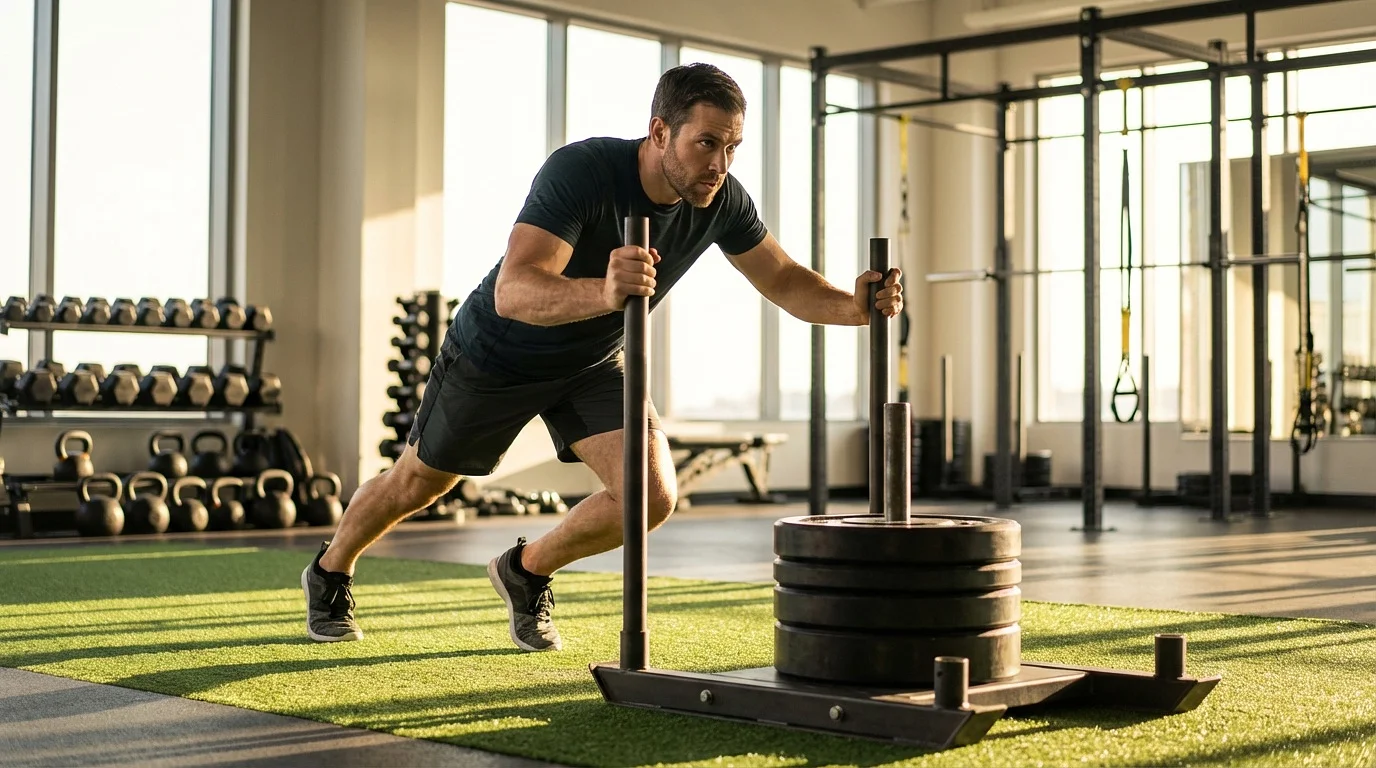
Sled push: low back and hip flexors
What it loads: a heavy horizontal push with a forward trunk lean, driven almost entirely by hip extension.
The sled is short. In competition it takes about 2.1 minutes [3]. But it is the highest external load of the day, and you produce it in a position where your trunk is angled forward and your low back is holding that angle isometrically while your legs churn.
The pain I hear about afterward:
- A deep, one-sided ache next to the spine that shows up the day after
- Low back tightness that makes the first few deadlift reps of the week feel foreign
- Hip flexor or front-of-hip pinching at the top of the drive
What I do about it: I check whether you can actually brace in a forward lean under load, because most people can brace standing tall and lose it at 45 degrees. Then I load that exact position on purpose with heavy carries, hip extension work, and split-stance pushes. If your back is already talking, the approach I use for lower back pain after deadlifts transfers almost directly here.
Burpee broad jumps: calf and Achilles
What it loads: repeated jumping and landing, from the floor, with a fatigued posterior chain.
Eighty meters of burpee broad jumps is a lot of stretch-shortening cycles through the calf and Achilles, and you are doing them after the sleds have already emptied your legs. This is the classic setup for the lower-leg category that made up 13.7% of injuries in the survey [1].
The tell is almost always the same. Stiff and sore for the first ten minutes of the morning, warms up, feels fine during training, then hurts again that night. That is a tendon giving you a report card, not a warning siren.
What I do about it: I do not rest it. In a randomized controlled trial of athletes with chronic Achilles tendon pain, heavy slow resistance training produced results as good as eccentric training, with higher patient satisfaction at 12 weeks [4]. So we load it. Heavy, slow, controlled calf work, progressed over weeks, while you keep training everything else. The full progression is in my article on Achilles tendon pain.
Farmer's carry: grip, forearm, and elbow
What it loads: eight lengths of maximal grip with the forearm working the whole time.
Grip is the sneaky one. Nobody trains for a grip injury, and then 200 meters of loaded carries at minute 50 turns a quiet forearm into a loud elbow. What usually shows up is pain on the outside of the elbow when you grab something, or on the inside when you squeeze hard.
The tell:
- Pain gripping a coffee cup or a door handle the next morning
- A sore, tight forearm that feels like it needs to be stretched constantly
- Elbow pain that fires on the first pull of a set, not the last
What I do about it: I separate where it hurts before I load anything, because outside and inside elbow pain get different plans. I walk through both in lifter's elbow. If the ache is lower, down toward the hand, look at wrist pain from lifting instead.
Sandbag lunges: quad and patellar tendon
What it loads: deep, repeated knee flexion under a load carried high on the back, with almost no recovery between reps.
A hundred meters of lunges with a sandbag is a huge amount of work for the quad and the tendons at either end of it. And you get to it around minute 60, when your ability to control the descent is already gone. That is why the knee is the single most-injured region in this sport at 20.8% [1].
Two different aches come out of it. Above the kneecap points at the quad tendon. Below the kneecap points at the patellar tendon. Both respond to the same principle and to different loading angles.
What I do about it: slow, heavy, controlled knee flexion under load, built back up over weeks, plus a hard look at how much lunging volume you added and how fast. If it is the ache above the kneecap, that is quadriceps tendonitis. If squatting is what sets it off, start with knee pain from squatting.
Wall balls: shoulder and knee
What it loads: everything, at the worst possible time.
Wall balls are the hardest station in the race by every measure. In competitive athletes they produced the highest heart rate (183 bpm), the highest blood lactate (8.5), and the highest rated exertion (18 out of 20) of any station [3]. A hundred reps of a squat plus an overhead throw, with your grip already cooked and your legs already gone.
The shoulder is where this shows up. Across functional fitness research, the shoulder is consistently the most-reported injury region, appearing in 9 of 12 studies in one systematic review [5], and accounting for 25.9% of injuries in a CrossFit meta-analysis [2].
The tell:
- A pinch at the top of the throw, not at the bottom of the catch
- Front-of-shoulder ache that shows up on pressing later in the week
- Shoulders that feel fine warm and stiff cold
What I do about it: I look at what your shoulder does when it is tired, not when it is fresh, because the last 30 reps are the ones that hurt you. Then we build overhead capacity under fatigue. If pressing is what aggravates it, bench press shoulder pain covers the approach, and dry needling for shoulder pain covers when I add that on top.
What I actually do about all of it
Four things, in this order.
1. Find the load that caused it, not just the tissue that hurts. Gradual onset in 57.4% of cases [1] means we are looking for a change in volume, not a moment. Usually it is a training block that jumped.
2. Load it instead of resting it. Tendons get stronger by being loaded heavily and slowly, and the trial evidence supports that over passive rest [4]. Complete rest makes the tendon feel better for two weeks and worse the moment you race.
3. Keep you training. You do not stop. We change what you do, how much, and how fast, and we leave the rest of the plan alone. That is the whole point of one-on-one care: I get to build the plan around your race, not around a template.
4. Cap the jump. The one risk factor the research isolated was how often you train the sport [1]. Adding race-specific volume is the goal. Adding it in three weeks is the injury.
If your race is still ahead of you, the prevention side of this lives in my HYROX prehab guide.
Conclusion
HYROX hurts people in a predictable way. Half of athletes report an injury in a year, most of it builds slowly, and most of it is tendon. The stations each have a signature, and the running between them does more damage than any of them. None of that means you should stop.
It means the fix is loading, not resting, and it starts with finding what changed in your training. I do that every week with lifters and hybrid athletes in Waukee, and it almost never requires pulling you out of the gym. That is what sports physical therapy looks like here.
If something is nagging and you want a real plan before your next race, reach out here.
References
- Ketzer C, Kirstein L, Bonleitner M, et al. Injury epidemiology in HYROX athletes: an international cross-sectional survey. medRxiv. 2026. https://doi.org/10.64898/2026.08.09.26359590
- Hülsmann M, Reinecke K, Barthel T, Reinsberger C. Musculoskeletal injuries in CrossFit: a systematic review and meta-analysis of injury rates and locations. Deutsche Zeitschrift für Sportmedizin. 2021;72:351-358. https://doi.org/10.5960/dzsm.2021.504
- Brandt T, Ebel C, Lebahn C, Schmidt A. Acute physiological responses and performance determinants in Hyrox, a new running-focused high intensity functional fitness trend. Frontiers in Physiology. 2025;16:1519240. https://doi.org/10.3389/fphys.2025.1519240
- Beyer R, Kongsgaard M, Hougs Kjær B, Øhlenschlæger T, Kjær M, Magnusson SP. Heavy slow resistance versus eccentric training as treatment for Achilles tendinopathy: a randomized controlled trial. American Journal of Sports Medicine. 2015;43(7):1704-1711. https://doi.org/10.1177/0363546515584760
- Barranco-Ruiz Y, Villa-González E, Martínez-Amat A, Da Silva-Grigoletto ME. Prevalence of injuries in exercise programs based on CrossFit, Cross Training and High-Intensity Functional Training methodologies: a systematic review. Journal of Human Kinetics. 2020;73:251-265. https://doi.org/10.2478/hukin-2020-0006
Medical disclaimer: This article is for educational purposes and is not personal medical advice. Consult a healthcare provider about your specific situation. Individual results may vary.