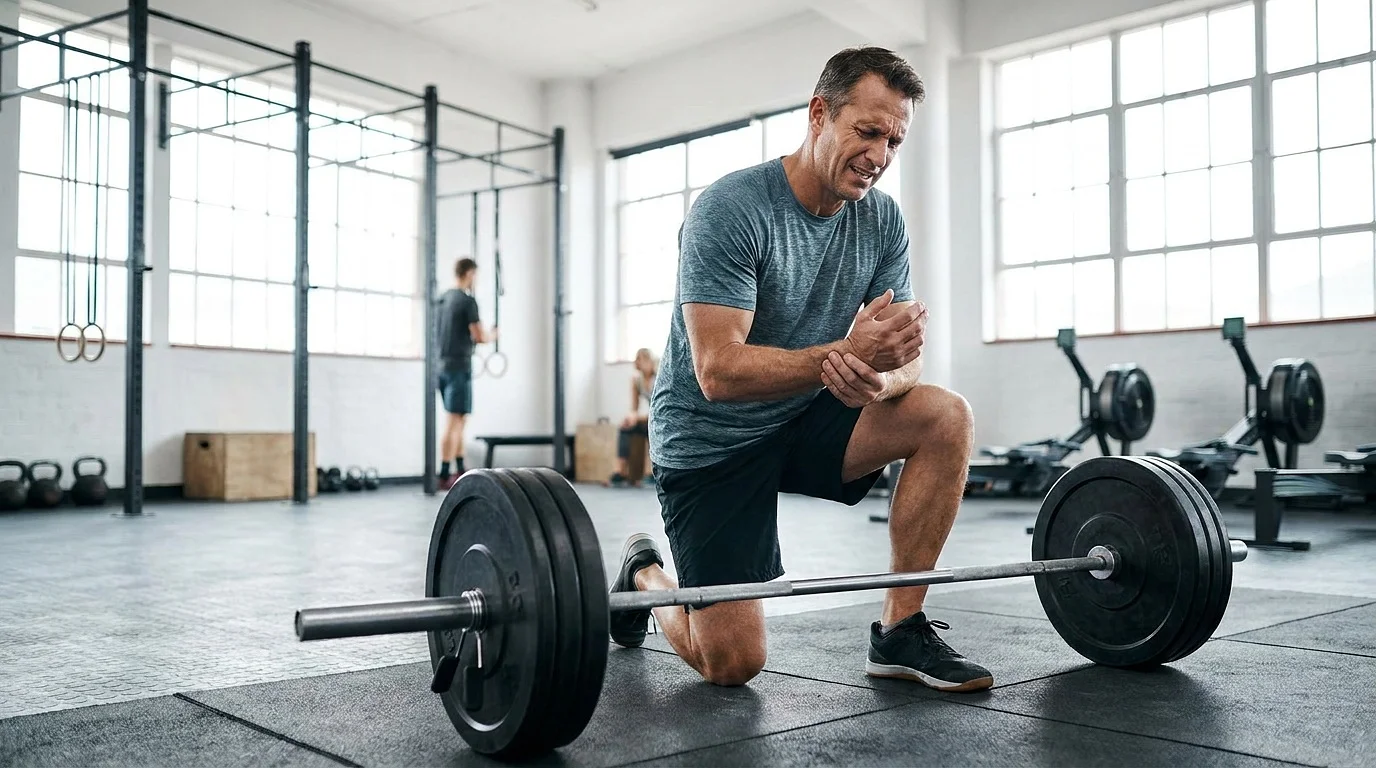
If your wrist bites you at the top of a front squat, in the catch of a clean, or halfway through a set of push-ups, you are in good company. Wrist pain from lifting is one of the most common complaints I see in the CrossFit and barbell crowd. In one study of CrossFit athletes, about one in five reported a hand or wrist injury, and roughly three out of four of those first-time injuries landed at the wrist. Here is the part you usually get told that I disagree with: rest it, wrap it, and hope. In my clinic I see the same thing week after week, and the wrist is almost never damaged. It is under-prepared for the load you are asking of it in the rack position and overhead. Let me walk you through what is actually going on, how to tell sore from serious, and how to keep cleaning and pressing while it settles.
Why does my wrist hurt when I lift?
Your wrist is a small joint doing a big job. In the lifts you actually do, it takes three things at once: load pushed straight through it, extension (the wrist bent backward), and rotation. Stack those together often enough and you have the exact recipe that irritates a wrist.
Think about where that shows up in a session:
Front rack and cleans: the bar sits across your fingers and the wrist is driven into deep extension under load.
Push-ups, burpees, and wall balls: your bodyweight loads the wrist while it is bent back.
Overhead and the snatch: load runs straight down through a wrist that has to stay stacked.
Heavy grip work: cleans, pull-ups, and carries load the forearm muscles that cross the wrist.
Most wrist pain in lifters falls into one of three buckets: a pinch at the back of the wrist, an ache on the pinky side, or a tired, sore feeling through the forearm and into the wrist. Knowing which one you have changes what you should do about it.
Front rack and cleans: is it dorsal wrist impingement?
If your pain is a sharp pinch at the back of the wrist, right at the top of a front squat or in the catch of a clean, the most likely culprit is dorsal wrist impingement. Dorsal just means the back of the wrist. When you drive the joint into the very end of its extension range under load, the tissues on the back can get compressed and pinched between the bones. Do that a few hundred times a week and it gets angry.
This is a classic lifter, CrossFit, and gymnast problem, because all three load the wrist in deep extension over and over. The tell is that it hurts most at the bottom of the position, where your wrist is bent back the furthest, and it eases when you back out of that end range. It is a position-and-load problem, not a sign your wrist is falling apart.
Pinky-side pain: could it be a TFCC injury?
If your pain sits on the pinky side of the wrist, especially when you load it and rotate at the same time, it may involve the TFCC. The triangular fibrocartilage complex is a small structure that acts as the main shock absorber and stabilizer on that side of the wrist. Research on athletes points to repetitive load through the wrist combined with rotation and side-to-side movement as a common way it gets irritated, and lifting heavy at the gym is squarely on that list.
Signs it might be more than ordinary soreness:
Pain on the pinky side when you press, rotate, or bear weight through the hand
Clicking, catching, or a feeling that the wrist is not quite stable
Pain that flares with twisting rather than easing as you warm up
A cranky TFCC can usually be managed well, but it is worth getting it looked at rather than grinding through it blindly.
How do I know if my wrist pain is serious?
Most training wrist pain is a load-and-position problem you can work with. Some of it deserves a proper assessment first. Get it checked if you have any of these:
Swelling that hangs around or does not settle between sessions
Pain at night or at rest, not just under load
Numbness, tingling, or pins and needles into the hand or fingers
A sense of the wrist giving way, locking, or catching
A specific pop or snap with sudden pain, or pain after a fall
Signs it is usually safe to train around with smart modifications: a stiffness or ache that warms up and settles within the session, soreness that stays local, and no numbness or instability. When in doubt, get assessed. It is a short conversation that can save you months of guessing.
Mobility or stability: what does my wrist actually need?
Here is the mistake I see most often. A lifter with wrist pain spends weeks stretching the wrist into more extension, trying to open up the front rack, and it never gets better. Sometimes it gets worse.
The reason is simple. If your pain is an end-range compression problem like dorsal impingement, or an irritated TFCC, shoving the joint deeper into the position that hurts is not the fix. You do want enough usable extension to rack a bar comfortably, so if you are genuinely stiff, some targeted mobility helps. Past that point, though, the answer is not more range it is more tolerance. The wrist needs to get stronger and better at controlling load, not just bend back further. Mobility where you are actually tight, strength and control where you are not. That one distinction sorts out a lot of stubborn wrists.
Do wrist wraps actually help?
Wrist wraps have a place, but not the one most people think. When researchers have tested them, wraps did not increase bench press strength, power, or endurance, and they did not boost grip strength either. What athletes did report was a subjective sense of stability. The wrist simply felt more supported.
So use them as a tool, not a cure:
Good use: heavy or near-max pressing, or a symptomatic day when a little support lets you train well.
Poor use: cranking them on for every warm-up set, or leaning on them to mask pain you should actually address.
And be clear-eyed about front-rack pain. A wrap adds external support, but dorsal impingement is a problem of end-range extension and compression. A wrap does not change the position your wrist has to reach to catch a clean, so it is rarely the answer for that specific pain. Build the wrist up rather than strapping over the problem.
How do I keep training while my wrist settles?
This is the part I care about most, because the answer is almost never stop. Your wrist, like any tissue, needs load to adapt. The goal is to modify so you keep training in a range that does not flare you, then rebuild capacity from there.
Change the position, not the whole plan:
Front rack and cleans: widen your grip, use a cross-arm or genie rack for front squats, or use clean-grip straps so the bar does not force the wrist to its end range. Drop to a load that feels clean, then build back up.
Push-ups, burpees, wall balls: put your hands on dumbbells or push-up handles, or drop to your fists, so the wrist stays closer to neutral instead of fully bent back. Scale the volume that is flaring you.
Pressing: shift toward dumbbell or neutral-grip pressing to take the wrist out of hard extension while you settle things down. If pressing is your bigger issue, my guide to training through bench press shoulder pain uses the same keep-training approach.
Then build the wrist back up. The tissues that cross the wrist respond to progressive loading the same way every other tendon and muscle does: start where it is tolerable and add load over time. In practice that means wrist extension and flexion work plus grip loading, often beginning with holds and easy ranges and progressing to heavier, slower strength work as it calms down. This is the same loading logic that fixes stubborn forearm problems like lifter's elbow, and it beats resting and hoping every time.
How we treat wrist pain at Fortitude & Freedom
My first job is figuring out which wrist problem you actually have, because dorsal impingement, a TFCC issue, and a forearm and grip overload do not all get treated the same way. From there the plan is the standard here: keep you training with the right modifications while we build the wrist and forearm capacity you were missing. When a tight forearm is part of the picture, dry needling can help calm it down so you can load sooner. I work with lifters and CrossFit athletes every week, so this is not about pulling you out of the gym. It is about getting your front rack to stop biting back. If you want the bigger picture on how I work with barbell athletes, here is what powerlifters actually need from PT.
The bottom line
Wrist pain in the gym is usually a load-and-position problem, not a reason to stop training. Learn the difference between sore and serious, build tolerance instead of only stretching, treat wraps as a tool rather than a crutch, and modify your grip so you keep cleaning and pressing. If your wrist keeps biting back and you are tired of guessing, book an assessment with Fortitude & Freedom and we will build you a plan that keeps you in the gym. That plan runs through sports physical therapy at the Waukee clinic.
This article is for education and is not medical advice. For a diagnosis and a plan built for you, get assessed by a qualified provider.
References