If you bench, you know the spot. That sharp twinge on the eccentric, the ache at lockout, the dull burn that lingers a day after a heavy session. Maybe it's been creeping in for weeks, maybe it showed up after a PR attempt, or maybe it's the same thing that flared up last winter and never fully cleared.
At Fortitude & Freedom in Waukee, I work with athletes who don't want to stop pressing. Here's what I do with shoulder pain that shows up on the bench, when it's safe to keep training, and how rehab gets built around the lift instead of pulling you away from it.
What's actually happening when your shoulder hurts on the bench
Bench press shoulder pain almost always traces back to one of four structures: the rotator cuff, the AC joint, the anterior capsule, or the long head of the biceps tendon. The tissue is irritated, sensitized, or under more load than its current capacity can handle. That last word is the important one. Most lifters don't have a structural injury. They have a capacity gap. The bench is asking the tissue for more than it's ready to give, and the tissue is telling you about it.
The four most common patterns I see:
Rotator cuff tendinopathy. Aching at the front or side of the shoulder, worse with the eccentric, often after a stretch of high pressing volume.
AC joint irritation. Sharp pain right at the top of the shoulder, often worse near lockout and with cross-body movements.
Anterior capsule sensitivity. Pain or pinching deep in the front of the shoulder at the bottom of the press, often worse with wider grips and an aggressive arch.
Long head of the biceps tendon. Pain on the front of the shoulder that runs down toward the bicep, often worse with bench dips, narrow grips, or pulldowns.
The good news for all four: the tissue responds to loading, not rest. Backing off completely is rarely the right call. Modifying how you load it almost always is.
The setup changes that make the biggest difference
Before we talk rehab, we look at your bench setup. Three variables usually matter most.
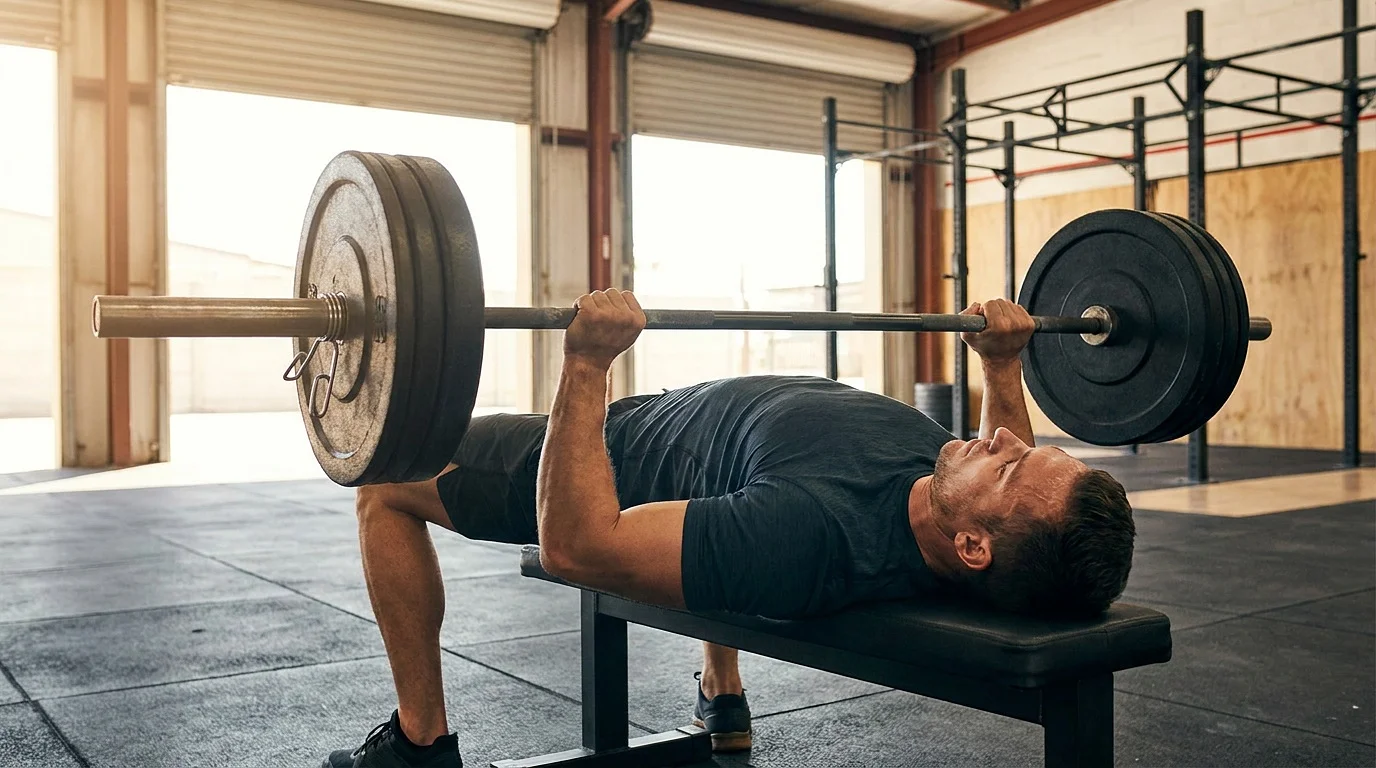
Grip width. A 2024 biomechanical analysis published in Sports Biomechanics found that a narrower grip (around 1.5 times biacromial width, which is roughly shoulder width and a couple of inches outside) reduces glenohumeral posterior shear force and lowers rotator cuff activity compared to wider grips. Translation: a narrower grip puts less stress on the structures most lifters tweak. If you've been benching with a powerlifting-wide grip and the shoulder is flagging, a temporary shift to a closer grip often calms things down within a session or two.
Bar path and elbow flare. Elbows tucked at roughly 45 to 60 degrees from your torso keeps the shoulder in a stronger, less impingement-prone position than wide-flared elbows at 90 degrees. Touch point on the lower chest tends to be friendlier than high on the sternum.
Scapular position. Pulling the shoulder blades down and back, then keeping them locked through the press, takes load off the front of the shoulder. A lot of lifters who shrug up or lose retraction at the bottom feel pain right where the cuff or capsule is doing extra work.
Most of the time, fixing setup buys you 50 to 70 percent of the relief without changing weight or volume.
When to train through and when to back off
Here's the rule I use with every lifter: pain monitoring, not pain avoidance.
The research behind this comes from Karin Silbernagel's pain-monitoring model, originally developed for Achilles tendinopathy and now applied across loaded rehab. The criteria are simple:
Pain stays at or below 5 out of 10 during the activity.
Pain doesn't get worse session to session.
Whatever ache you feel after training resolves and returns to baseline by the next day.
If all three hold, you keep pressing. You might modify the weight, the variation, the grip, or the volume, but the lift stays in the program. Silbernagel's 2007 randomized trial showed athletes following this model recovered just as well as those who fully rested, with no negative effect on outcomes at 12 months.
If pain spikes past 5, gets sharper, or carries over into the next day, that's the signal to pull back. Not stop. Pull back. Drop intensity, swap to a friendlier variation (floor press, board press, dumbbell), or reduce volume for the week while we work on the underlying capacity.
What rehab actually looks like
The 2025 Journal of Orthopaedic & Sports Physical Therapy clinical practice guideline on rotator cuff tendinopathy puts progressive resistance training at Grade A evidence. That's the highest tier the guideline assigns. The recommendation is clear: prescribe an active rehab program with motor control and progressive resistance loading, individualized to the patient's pain tolerance and goals.
In plain language, that's what we do. The rehab IS lifting, programmed for the tissue that's irritated.
A typical block looks like this:
Weeks 1 to 2: Calm the tissue, find the capacity floor. Isometric holds at positions that don't aggravate, light dumbbell work in pain-free ranges, manual therapy and dry needling as needed. The bench stays in the program at reduced load or a friendlier variation.
Weeks 2 to 4: Loaded progression. We push the capacity envelope week by week. Heavier dumbbell pressing, paused tempo work, slow eccentrics. The bench moves back toward your normal grip and intensity as the shoulder tolerates it.
Weeks 4 to 8: Return to full intent. You're back on the competition lift at working weights. We monitor symptoms, dial accessory volume, and confirm the irritated structure has the capacity to handle your training block.
A 2024 systematic review with meta-analyses in JOSPT by Naunton and colleagues confirmed the active ingredient across the rotator cuff exercise literature is progressive overload. Frequency, intensity, time, and type all matter, but the load progressing over time is what moves outcomes.
When to see a PT instead of working it out yourself
A lot of bench shoulder pain resolves with the setup changes and pain-monitored loading above. Some doesn't. Here are the signals worth a clinical eye:
Pain that's sharp or worsens despite modification across two or three weeks
Loss of range of motion (you can't get your arms overhead or behind your back like you used to)
Numbness, tingling, or radiating symptoms into the arm
A specific traumatic event (a pop, a sudden tear sensation, immediate swelling)
A meet or competition on the calendar and the symptom isn't trending in the right direction
If any of those apply, getting an assessment under load with someone who lifts is the move. We watch your actual bench, screen the surrounding structures, build the plan around your training block, and figure out which lever to pull.
Frequently asked questions
Should I stop benching if my shoulder hurts?
Usually not. Most bench shoulder pain responds better to modified loading than to rest. Adjust grip width, intensity, or variation while the tissue calms down.
How long does bench shoulder pain take to heal?
Most cases resolve in four to eight weeks of consistent loaded rehab. Acute tweaks can clear in two to three weeks. Longstanding tendinopathy may take twelve weeks or more.
Will dry needling help bench shoulder pain?
Often, yes. Dry needling can reduce muscle tone and sensitivity in the rotator cuff, traps, and pec, which pairs well with loaded rehab. It works best as part of a broader plan, not as a standalone fix.
Is shoulder pain on the bench a sign of a rotator cuff tear?
Almost never. The vast majority of bench shoulder pain is tendinopathy or joint irritation, not a tear. If you have sharp pain with a clear traumatic onset, weakness, or significant loss of range of motion, get it looked at.
Can I bench heavy again after a shoulder injury?
Yes, in most cases. Returning to heavy pressing after a shoulder issue is a programming and progression question, not a structural one. A criterion-based progression matters more than the calendar.
Do I need a referral to see a PT in Iowa?
No. Iowa has direct access for physical therapy. You can book at Fortitude & Freedom without a physician referral.
Train through it, not around it
Bench shoulder pain doesn't have to take you out of the gym. The right setup adjustments, a pain-monitored loading approach, and a rehab plan that uses the lift as the rehab will get most lifters back to full intent in a matter of weeks, not months.
If you're benching through pain in Waukee, Des Moines, or the surrounding metro and want a plan built around your training block, book a free injury screen at fortitudeandfreedom.com/contact. We'll figure out what's flagging and what to do about it.
Dr. Jake Pawol, PT, DPT, OCS, is the owner of Fortitude & Freedom Performance Therapy in Waukee, Iowa. He is a board-certified orthopedic clinical specialist and a competitive lifter who specializes in keeping athletes training through rehab.
Medical disclaimer: This article is for educational purposes only and is not a substitute for individualized medical advice. Consult a healthcare provider for evaluation of any specific symptom. Individual results may vary.
References
Stastny P, Maszczyk A, Tufano JJ, et al. Effects of bench press technique variations on musculoskeletal shoulder loads and potential injury risk. Sports Biomech. 2024. PubMed 38974522
Silbernagel KG, Thomeé R, Eriksson BI, Karlsson J. Continued sports activity, using a pain-monitoring model, during rehabilitation in patients with Achilles tendinopathy: a randomized controlled study. Am J Sports Med. 2007;35(6):897-906. PubMed 17307888
Desmeules F, Dionne CE, Lowry V, et al. Rotator Cuff Tendinopathy Diagnosis, Nonsurgical Medical Care, and Rehabilitation: A Clinical Practice Guideline. J Orthop Sports Phys Ther. 2025. JOSPT 2025.13182
Naunton J, Street G, Littlewood C, et al. The Efficacy of Exercise Therapy for Rotator Cuff-Related Shoulder Pain According to the FITT Principle: A Systematic Review With Meta-analyses. J Orthop Sports Phys Ther. 2024. JOSPT 2024.12453