That first step out of bed is the worst part of your day. Your heel feels like you are standing on a bruise or a tack, it eases up once you get moving, then it comes roaring back after you sit for a while or finish a run. If you run or lift, you probably tried the obvious move first: back off, rest it, wait for it to settle. It felt better for a bit, then returned the moment you loaded it again. That is the frustrating loop with plantar fasciitis, and it is the exact problem I help active people in Waukee solve. In this guide I will explain what plantar fasciitis actually is, why your heel screams in the morning, and the loading-based plan I use to get runners and lifters back to training.
What is plantar fasciitis?
Plantar fasciitis is irritation and breakdown of the plantar fascia, the thick band of tissue that runs along the bottom of your foot from your heel to the base of your toes. It is the most common cause of pain on the bottom of the heel, and roughly two million people get treated for it every year, per the American Academy of Orthopaedic Surgeons.
Here is the part most people do not hear: the name is a little misleading. The "-itis" implies inflammation, but when researchers look at the tissue, they mostly find degeneration, the same wear-and-rebuild pattern you see in a cranky tendon, which is why some call it plantar fasciosis. That matters for one big reason. Inflamed tissue wants you to calm it down. Degenerating tissue wants the opposite: a smart, progressive load to rebuild it. Keep that in your back pocket, because it explains why rest alone keeps letting you down.
Why does my heel hurt most on the first steps in the morning?
Because your foot has been pointed down all night. While you sleep, your ankle relaxes and the plantar fascia shortens. Those first steps in the morning suddenly stretch and load that shortened, sensitive tissue cold, and it protests. The AAOS describes this first-step pain after rest, whether it is getting out of bed or standing up after a long car ride, as the classic signature of plantar fasciitis.
The good news: that pattern is actually a useful sign. Pain that warms up as you move, then flares after rest, points to a tissue-tolerance problem we can train, not a structural emergency.
What causes plantar fasciitis in runners and lifters?
It almost always comes down to load outpacing what the tissue is ready for. A few common drivers I see in the gym:
- A quick jump in running volume. One prospective study of runners found higher rates of plantar fasciitis in those logging more weekly mileage, with risk climbing as distance went up (4HAIE running cohort).
- Limited ankle dorsiflexion or tight calves. Your calf, Achilles tendon, and plantar fascia work as one connected chain. When the calf is stiff, the fascia eats more of the load.
- A spike in impact. Adding sprints, box jumps, double-unders, or a lot of standing work without ramping up to it.
- New or worn-out footwear, or switching to a much flatter shoe overnight.
- Bodyweight changes and long days on your feet.
Notice the theme. None of these mean your foot is fragile. They mean the load went up faster than the tissue adapted. Fix the load, train the tissue, and the heel follows.
Does resting fix plantar fasciitis?
Rest takes the edge off, and that is why it is tempting. When you stop loading the fascia, the irritation settles and the morning pain fades. The problem is what happens next. Rest calms the symptoms without building any capacity, so the tissue stays just as unprepared as the day you stopped. The first real run or heavy session loads it again, and you are right back where you started.
This is the same trap I see with shin splints: time off feels productive, but it is not the same as getting stronger. The fix is not to avoid load. It is to give the fascia the right load, in the right dose, so it rebuilds.
How do you actually treat plantar fasciitis?
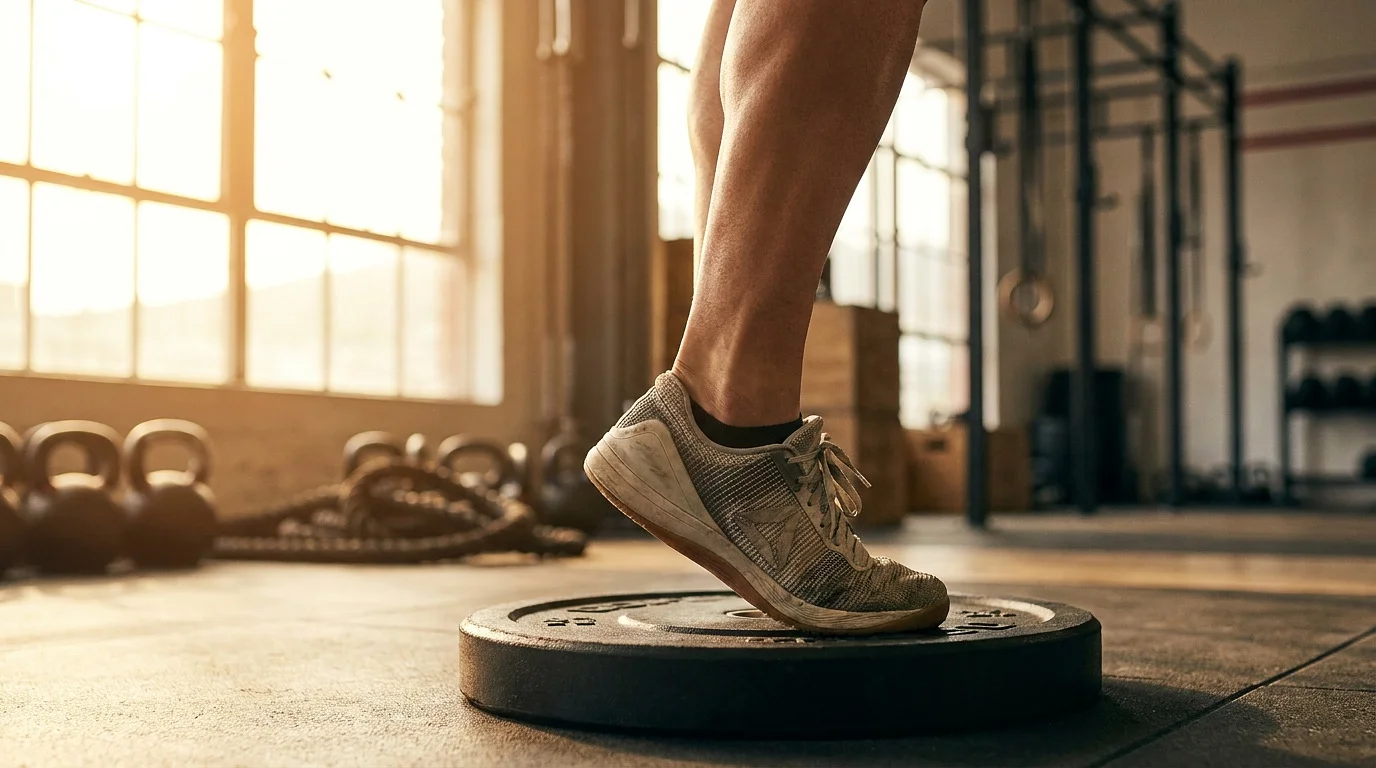
You treat it by loading it on purpose. The strongest evidence points to progressive strength work for the foot and calf, paired with hands-on care and targeted stretching. In a randomized trial, patients who did high-load strength training, meaning slow, heavy heel raises with a towel bunched under the toes, scored markedly better on foot function at three months than those who only stretched (Rathleff 2015). The 2023 clinical practice guideline in the Journal of Orthopaedic and Sports Physical Therapy lands in the same place: resistance training for the foot and ankle, manual therapy, and plantar-fascia plus calf stretching, used instead of passive electrotherapy.
Here is the core of what that looks like in my clinic:
| Piece |
What it is |
Why it works |
| High-load heel raises |
Slow calf raises with a towel under the toes, every other day, building to heavy |
Rebuilds the calf and fascia under real load (Rathleff protocol) |
| Foot and calf strength |
Progressive loading for the arch, calf, and big toe |
Restores capacity so daily impact stops overloading the fascia |
| Manual therapy |
Hands-on work to the foot, ankle, and calf |
Reduces pain and restores motion so you can train (JOSPT 2023) |
| Targeted stretching |
Plantar-fascia-specific and calf stretching |
Short and long-term pain relief (JOSPT 2023) |
| Graded return |
A planned ramp back to running and lifting |
Reloads the tissue without re-spiking it |
The theme is simple: we do not chase zero pain by hiding from load. We rebuild the foot's tolerance step by step. It is the same loading philosophy we use for sciatica and most of the stubborn stuff that never responded to rest.
What about orthotics, night splints, and shockwave?
These have a role, mostly as support around the main work, not as the fix on their own.
- Shoe inserts and orthotics can ease symptoms in the short term, which buys you room to train. The 2023 guideline supports using foot orthoses, often alongside stretching and manual therapy.
- Night splints keep the fascia from shortening overnight and can take the bite out of those first morning steps for some people.
- Shockwave therapy (ESWT) has solid evidence for stubborn, long-running cases that have not responded to a few months of good rehab. A meta-analysis found it meaningfully improves pain and function in plantar fasciitis (systematic review).
And one myth worth busting: the heel spur. Plenty of people get an X-ray, see a spur, and assume that is the culprit. But about 1 in 10 people have a heel spur and only around 1 in 20 of those have any foot pain (AAOS). The spur usually is not your problem, and you rarely need to remove it. The fascia's load tolerance is the real lever.
Can I keep running and lifting while it heals?
Usually yes, with adjustments. You do not have to shut everything down. We dial the load to a level your heel can handle, keep the parts of training that do not flare it, and build back the rest on a plan. For a runner that might mean trimming volume and adding strength work for a few weeks instead of going to zero. For a lifter it might mean adjusting stance, footwear, or standing volume while we load the calf and foot hard.
Keeping you training is the whole point of how I work, the same way I approach physical therapy for lifters. The goal is to keep you moving toward your goal, not to park you on the couch.
How long does plantar fasciitis take to heal?
Be patient and honest with yourself: plantar fasciitis is usually a matter of months, not days. Most cases improve over time, and loading speeds up the part you care about, which is getting back to comfortable training. In the Rathleff trial, the strength group pulled clearly ahead by three months (Rathleff 2015). The earlier you start loading instead of just resting, the sooner you tend to turn the corner. Stick with the plan, ramp gradually, and do not bail the moment it feels better. That is how it sneaks back.
Plantar fasciitis treatment in Waukee, Iowa
If your heel pain is not budging, that is what I do here at Fortitude and Freedom Performance Therapy in Waukee. We start with a full movement evaluation: your ankle mobility, calf and foot strength, your gait, and how your training load has been trending. From there you get a specific loading plan built around your sport, whether that is running, lifting, HYROX, or just staying active without your heel running your day.
Care is one-on-one and gym-based, so you are practicing the loads you actually need to get back to. If dry needling fits your case, I will use it for the calf and foot as part of the plan, the same approach I take to dry needling for other stubborn spots.
Frequently asked questions
Should I stop running with plantar fasciitis?
Usually no. Most runners can keep running at a reduced load while we build foot and calf strength. Full rest tends to feel good briefly and then disappoint, because it does not build any capacity.
Is a heel spur causing my pain?
Probably not. Heel spurs are common and usually painless. The plantar fascia's load tolerance, not the spur, is almost always the real issue (AAOS).
Is plantar fasciitis permanent?
No. The large majority of cases resolve, especially with a progressive loading plan. It can be stubborn, but it is treatable.
What is the fastest way to fix plantar fasciitis?
There is no overnight fix, but the fastest route is progressive strength work for the foot and calf, plus targeted stretching and hands-on care, started early, rather than rest alone (Rathleff 2015).
Does dry needling help plantar fasciitis?
It can be a useful add-on for calf and foot tightness alongside the loading plan. It is a tool in the kit, not the whole plan.
The bottom line
Plantar fasciitis is not a sign your foot is broken, and it is not something you have to wait out on the couch. It is a load-tolerance problem, and the fix is to rebuild that tolerance with the right strength work, the right stretching, and a smart ramp back to your training. Rest alone keeps you stuck in the loop. Loading gets you out of it. If your heel has been calling the shots, let's build a plan to take that power back. Reach out through our contact page and let's get you back to the miles and the lifts you love.
This article is for education and is not medical advice. Heel pain can have more than one cause, so please get evaluated by a qualified healthcare provider before starting a new treatment or training plan. Individual results vary.
References
- American Academy of Orthopaedic Surgeons (OrthoInfo). Plantar Fasciitis and Bone Spurs. https://orthoinfo.aaos.org/en/diseases--conditions/plantar-fasciitis-and-bone-spurs
- Rathleff MS, Molgaard CM, Fredberg U, et al. High-load strength training improves outcome in patients with plantar fasciitis: a randomized controlled trial with 12-month follow-up. Scand J Med Sci Sports. 2015. https://onlinelibrary.wiley.com/doi/10.1111/sms.12313
- Koc TA Jr, Bise CG, Neville C, et al. Heel Pain, Plantar Fasciitis: Revision 2023. J Orthop Sports Phys Ther. 2023;53(12). https://www.jospt.org/doi/10.2519/jospt.2023.0303
- Running Distance and Biomechanical Risk Factors for Plantar Fasciitis: a 1-year prospective 4HAIE cohort study. https://pmc.ncbi.nlm.nih.gov/articles/PMC11878588/
- Extracorporeal shock wave therapy in patients with plantar fasciopathy: a systematic review with meta-analysis. https://pmc.ncbi.nlm.nih.gov/articles/PMC11561739/