You set up under the bar, hit depth, and there it is: a sharp pinch in the front of your knee, or a deep ache that shows up on the way down and hangs around after your last set. Maybe it started after a hard training block where you pushed volume, and now every squat session has you wondering if you need to shelve the barbell for good. I get how frustrating that is. The squat is the lift that makes everything else work, and being told to just avoid it feels like a dead end. Here is the good news: knee pain from squatting is almost always a load problem, not a broken knee, and load problems are fixable. In this article I will walk you through what is actually causing it and exactly how to keep training while it calms down.
Why does my knee hurt when I squat?
Most squat-related knee pain comes down to a single tissue getting loaded faster than it adapted, not to squatting being dangerous. Here is what I see most often in the gym and in my evals:
Patellofemoral pain (the kneecap itself). An achy, hard-to-pinpoint pain behind or around the kneecap that gets worse with deep reps, stairs, and long sits in the car. This is the same mechanism behind runner's knee, and it responds to the same fix.
Patellar tendinopathy (just below the kneecap). A pinpoint pain on the tendon right under your kneecap that often warms up during your session and then aches the next morning. Tendons are load-hungry tissues, and this one flares when the load outpaces its capacity.
Quad tendinopathy (just above the kneecap). The same story as patellar tendinopathy, one inch higher. Common in heavy low-bar squatters.
A load spike, not a bad knee. Sometimes the tissue is healthy and the training simply jumped too fast. A big bump in volume, intensity, or squat frequency inside a short window is one of the most common triggers I see.
Setup and mobility inputs. Limited ankle mobility or a stance that does not fit your hips can concentrate stress at the knee. These are adjustable inputs, not a permanent flaw.
If you are not sure which one you are dealing with, that is exactly what an eval sorts out.
Is squatting actually bad for your knees?
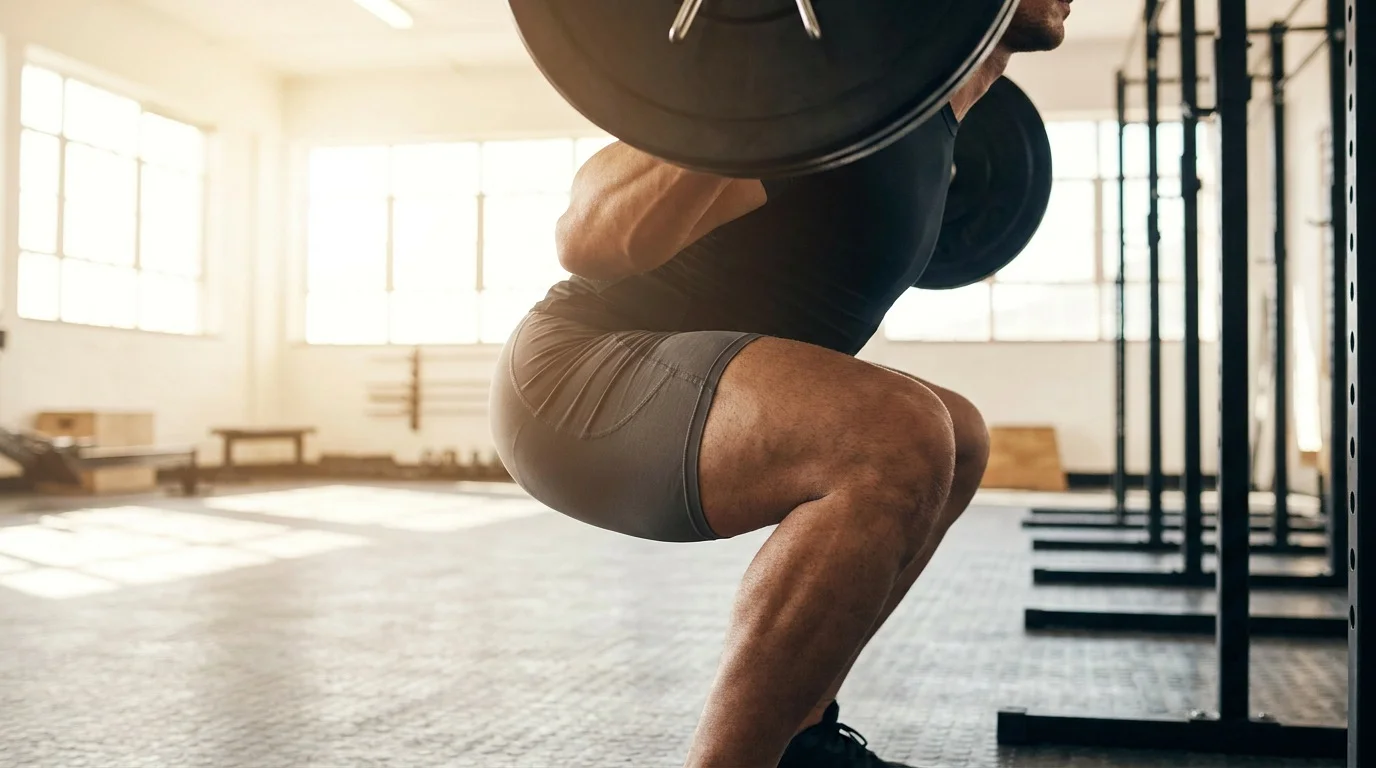
No. The research here is clear, and it points the other way. When a large systematic review examined how squat depth and load affect the knee, it found that deep squats with submaximal loads do not increase the risk of injury to knee structures, and that learning to squat deep with sound technique builds a more resilient lower body (Hartmann et al., Sports Medicine, 2013). A more recent scoping review reached the same verdict: of fifteen studies on deep squatting and knee-joint health, fourteen found no negative impact.
What does get people hurt is the opposite of deep, controlled squatting: heavy partial reps with supramaximal loads, or a training load that climbs faster than the knee can keep up. The squat is not the villain. Under-preparing the tissue for the squat is.
Should I stop squatting if my knee hurts?
Almost never completely. Knees and tendons adapt to the load you give them, and shutting everything down tends to leave the tissue less capable than when you started, so the pain returns the moment you come back. The better move is relative rest: keep training, but adjust the dose so you stay under your pain threshold while the tissue rebuilds. The tendon research has shifted hard in this direction over the last decade. Cook and Purdam's continuum model reframed tendon pain as a failed adaptation to load, with progressive loading, not rest, as the primary driver of recovery (British Journal of Sports Medicine, 2009).
In plain terms: total rest is a short-term painkiller with a long-term cost. Smart loading is the actual treatment.
How to keep squatting while your knee settles
You manage the load instead of removing it. Here is the approach I use with lifters, roughly in order:
Dial the dose, do not stop. Reduce depth, load, or tempo enough to bring the pain down to a low, tolerable level, then keep training there. You hold onto the squat pattern and the training habit.
Use isometrics for fast pain relief. Holds like wall sits or Spanish squats can drop tendon pain quickly. One well-known study found a single bout of isometric contractions reduced patellar tendon pain immediately and for up to 45 minutes afterward, with no loss of strength (Rio et al., BJSM, 2015). I use these before sessions and on sore days.
Rebuild capacity with heavy slow resistance. Slow, heavy strength work carried out over weeks is one of the best-supported ways to restore a tendon's tolerance (Kongsgaard et al., 2009). This is where the lasting progress comes from.
Train the hip and the quad together. For kneecap pain, combined hip and knee strengthening beats knee work alone, per the American Physical Therapy Association clinical practice guideline (JOSPT, 2019). Strong glutes and hips change how force lands at the knee. If your hips are part of the picture, hip work matters here too.
Fix the inputs. Ankle mobility drills and a stance that actually fits your build often take pressure off the knee without changing the lift you love.
For an in-clinic option that can calm a cranky tendon or kneecap while you keep loading, dry needling for knee pain is a tool I reach for alongside the strength work. It is all part of the same load-first philosophy behind everything we do for barbell athletes.
When should you see a physical therapist?
Get eyes on it if the pain is not improving after two to four weeks of smart training changes, or if you notice any of these:
Swelling that keeps coming back
The knee locking, catching, or giving way
Pain at night or at rest
Pain that keeps climbing no matter how you adjust
When you come in, the first thing I do is figure out which tissue is actually driving your pain and how much load it can handle right now. From there we build a plan that keeps you squatting, in some form, from day one. I am a board-certified orthopedic specialist and a competitive lifter, so I am not going to hand you a sheet of straight-leg raises and send you off for six weeks. We load you, we track it, and we get you back to full training as fast as the tissue allows. Getting back to your sport is the whole point, and that is a process we have dialed in.
The bottom line
Knee pain from squatting is a signal, not a stop sign. In almost every case it is your knee telling you the load got ahead of your capacity, and that is something you fix by training smarter, not by racking the bar for good. Adjust the dose, calm the pain with isometrics, rebuild with heavy slow strength, and get the hips involved. If it is not turning around on its own, let's get eyes on it. Book a visit through our contact page and let's get you back under the bar for good. You can see the full approach under sports physical therapy.
References
Willy RW, Hoglund LT, Barton CJ, et al. Patellofemoral Pain: Clinical Practice Guidelines Linked to the International Classification of Functioning, Disability and Health From the Academy of Orthopaedic Physical Therapy of the American Physical Therapy Association. Journal of Orthopaedic & Sports Physical Therapy. 2019;49(9):CPG1-CPG95. https://www.jospt.org/doi/10.2519/jospt.2019.0302
Hartmann H, Wirth K, Klusemann M. Analysis of the Load on the Knee Joint and Vertebral Column with Changes in Squatting Depth and Weight Load. Sports Medicine. 2013;43(10):993-1008. https://pubmed.ncbi.nlm.nih.gov/23821469/
Cook JL, Purdam CR. Is tendon pathology a continuum? A pathology model to explain the clinical presentation of load-induced tendinopathy. British Journal of Sports Medicine. 2009;43(6):409-416. https://bjsm.bmj.com/content/43/6/409
Rio E, Kidgell D, Purdam C, et al. Isometric exercise induces analgesia and reduces inhibition in patellar tendinopathy. British Journal of Sports Medicine. 2015;49(19):1277-1283. https://bjsm.bmj.com/content/49/19/1277
Kongsgaard M, Kovanen V, Aagaard P, et al. Corticosteroid injections, eccentric decline squat training and heavy slow resistance training in patellar tendinopathy. Scandinavian Journal of Medicine & Science in Sports. 2009;19(6):790-802. https://onlinelibrary.wiley.com/doi/10.1111/j.1600-0838.2009.00949.x
Impact of the deep squat on articular knee joint structures: friend or enemy? A scoping review. Frontiers in Sports and Active Living. 2024. https://www.ncbi.nlm.nih.gov/pmc/articles/PMC11618833/
This article is for general education and is not a substitute for individual medical advice. Consult a healthcare provider about your specific situation. Individual results may vary.