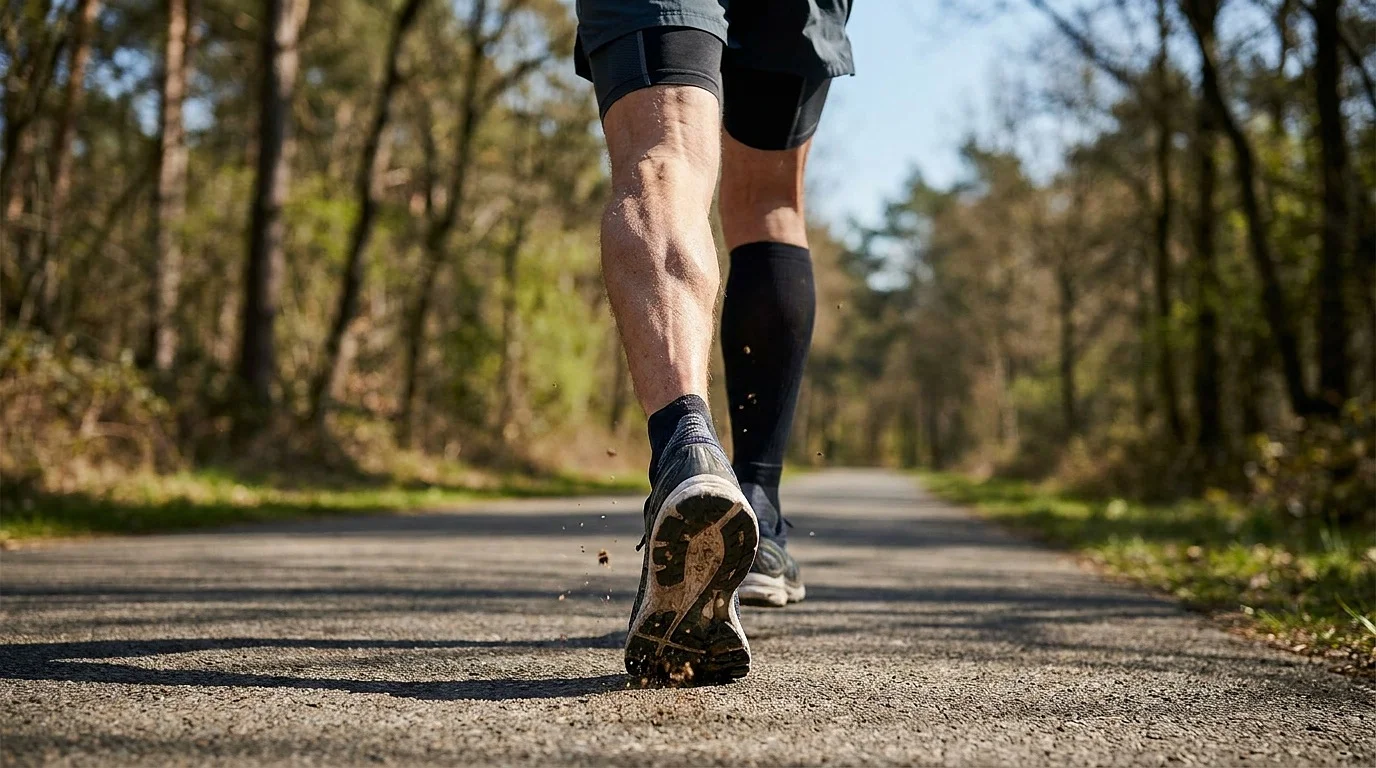
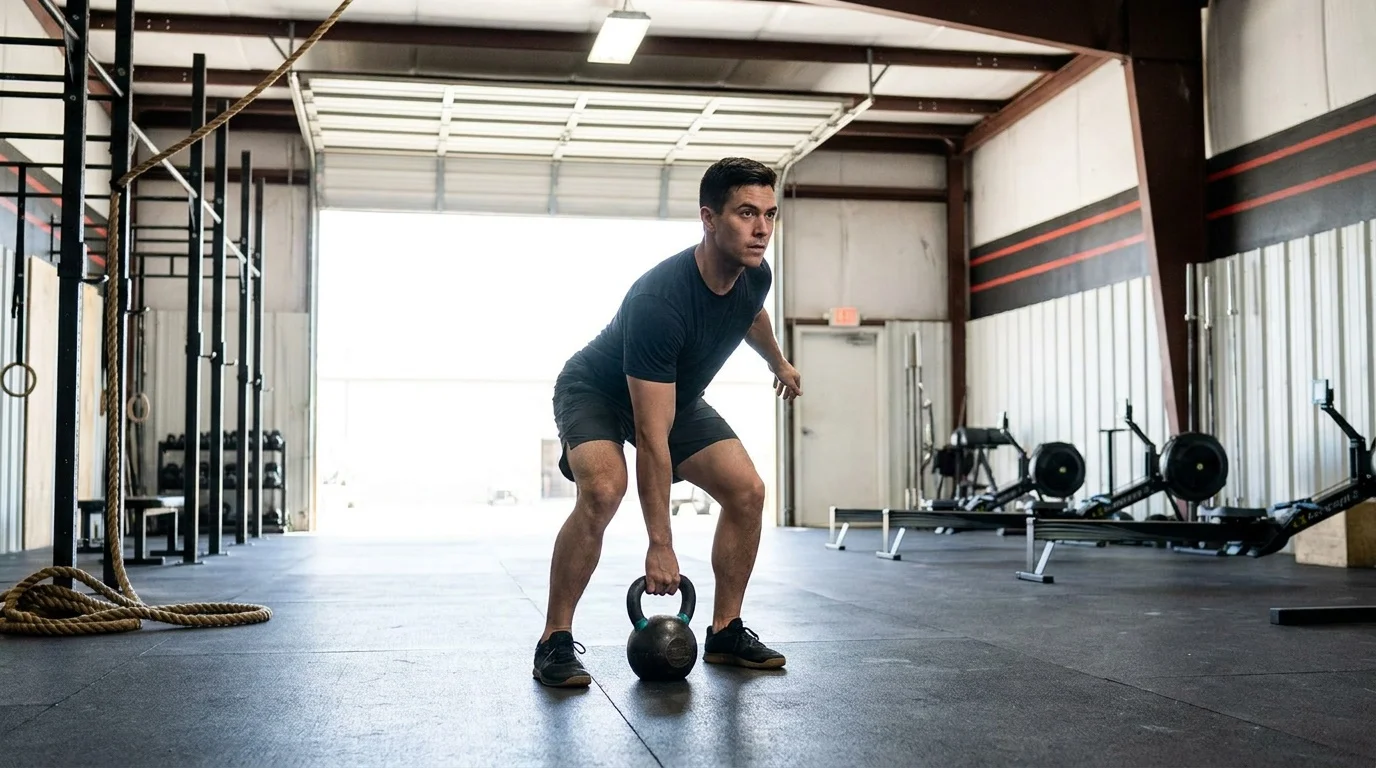
If you run, lift, or do anything with repeat impact, Achilles tendon pain has a way of showing up right when your training is getting good. The spring and summer ramp hits, your mileage climbs, race season starts, the box programming gets more jumps and double-unders, and one morning your heel cord is stiff and angry on the first few steps out of bed. You've probably been told the same thing most active people hear: rest it, ice it, wait it out. Effective Achilles tendon pain treatment for runners and lifters looks almost nothing like that. Here's how I think about it in my Waukee clinic, why rest is usually the wrong move, and the loading approach that actually rebuilds the tendon.
What Achilles Tendinopathy Actually Is
First, the name. What most people call "Achilles tendinitis" is usually Achilles tendinopathy. That distinction matters. "Itis" implies inflammation as the main problem. The research shows that persistent Achilles tendon pain is mostly a tendon capacity and structure problem, not a tendon that's simply inflamed [1][4]. The tendon has been asked to do more than it's currently built to handle, and it's responded by getting painful, stiff, and less tolerant of load.
There are two common locations, and they're not the same injury:
Midportion: pain and thickening about two to six centimeters above the heel bone. The most common version in runners.
Insertional: pain right where the tendon attaches to the heel. More irritable with compression, like deep stretching into dorsiflexion or downhill running.
Knowing which one you're dealing with changes the plan, so don't assume every heel cord problem gets treated the same way.
Why It Flares in Spring and Summer
Tendons don't usually break down because of one bad step. They break down because of a spike in load they weren't prepared for. Spring and summer is when those spikes happen. You go from winter base mileage to marathon block volume. You start outdoor running again after months on softer surfaces. You ramp up HYROX or race prep with more sled work, lunges, and running under fatigue. The CrossFit programming shifts toward more jumping and bounding.
The tendon can handle almost anything you build up to gradually. What it can't handle is a sudden jump in volume, intensity, or impact with no on-ramp. Almost every Achilles case I see in the gym traces back to a training error, not a weak tendon that "just happened." If you want to keep these spikes from turning into injuries in the first place, my guide on HYROX prehab and building durability before race day covers how I structure the ramp.
Why Rest Is the Wrong Fix
Here's the part that surprises people. Take six weeks completely off and the pain often does calm down, because you removed the load that was irritating it. Then you go back to running or lifting, and within a week or two it flares again, sometimes worse. That cycle is the single most common story I hear.
The reason is simple. Rest does nothing to build the tendon's capacity. While you wait, your calf gets weaker, the tendon gets less tolerant, and your running and lifting mechanics deteriorate. So you return to your sport with less capacity than you had when you got hurt, and the same load that irritated the tendon before now irritates it even faster. This is the same principle I wrote about for why rest is the wrong approach for sciatica. Tissue that hurts under load does not get fixed by removing all load. It gets fixed by the right load, at the right dose, at the right time.
Pain vs Damage
The fear with loading a painful tendon is that you'll make it worse. With tendinopathy, that's usually not how it works. The model I use with athletes, and the one supported by the clinical guidelines, allows some pain during loading as long as it stays manageable [1][4]. The practical rules I coach:
Pain at or below about a 5 out of 10 during the work is acceptable.
It should settle back to baseline within 24 hours.
No worse-than-usual stiffness the next morning, and no disrupted sleep.
Pain inside those guardrails is information, not damage. That's what lets us keep training you instead of shutting you down. It is the same criteria-first standard I use across sports physical therapy.
What Actually Works: Progressive Tendon Loading
Tendons remodel in response to heavy, slow, progressive load. That's the entire basis of modern treatment. The strongest evidence supports a structured strength program, and head-to-head trials show heavy slow resistance training and eccentric training both produce good, lasting results, with heavy slow resistance often earning higher patient satisfaction and better adherence [2][6]. Here's how I stage it:
Calm and load (isometrics). Early on, when the tendon is most irritable, I use isometric calf holds. They help with pain and start loading the tendon without the up-and-down stress that aggravates it.
Build capacity (heavy slow resistance). This is the engine of recovery. Slow, heavy calf and lower-leg strength work, progressed over time. The evidence points to loads in the heavy range and real progression, not endless light reps, because the tendon adapts to meaningful load and strain, not to busywork [3][5].
Restore spring (energy storage). Once strength is back, I add progressive hopping, bounding, and plyometric work so the tendon can store and release energy again. This is the step most rehab skips, and it's why people re-injure when they return to running.
Return to sport. Sport-specific loading that looks like your actual training. Mileage and pace for runners, jumps and barbell work for lifters, mixed-modal for HYROX and CrossFit athletes.
For barbell athletes specifically, I go deeper on how I program around an irritable lower leg in my piece on physical therapy for lifters.
Midportion vs Insertional: Why the Plan Changes
This is where cookie-cutter plans fail people. Midportion tendons usually tolerate full-range calf work fairly early. Insertional tendons get compressed and irritated at the bottom of that range, so early on I limit deep dorsiflexion, often start strength work on a flat surface instead of off a step, and progress range more carefully. Same principles, different dosing. Getting this wrong is a common reason a "good rehab program" stalls.
How I Treat Achilles Tendon Pain at Fortitude & Freedom
My job is to keep you training while we fix the tendon, not after. Here's what that looks like in practice. First, I find the training error that caused the spike, because if we don't change that, it comes back. Then I set a load the tendon can tolerate today and build from there, using the pain guardrails so you keep moving. We keep you doing as much of your sport as the tendon allows, modified, not deleted. And we progress with objective markers, not guesswork, so you know exactly when it's safe to add mileage or load.
That's the whole philosophy. Your rehab should look like your training, and you shouldn't have to disappear from your sport for six months to get there. How I structure the final return is the same framework I lay out in return to sport physical therapy.
When to Get It Looked At
Most Achilles tendon pain responds well to a smart loading plan, but a few situations need a professional eye sooner rather than later:
A sudden, sharp pop or snap in the back of the leg, especially with a feeling of being kicked, and trouble pushing off or rising onto the toes. This can indicate a tendon rupture and should be evaluated urgently.
Pain that isn't improving after several weeks of consistent, well-dosed loading.
Significant swelling, redness, or pain that doesn't follow the load pattern described above.
When in doubt, get it assessed by a licensed healthcare provider rather than guessing. A short evaluation can save you months.
Get Back to Training in Waukee
If Achilles pain is cutting your mileage, keeping you off jumps, or making you dread the first steps in the morning, that's exactly the problem I solve. My clinic is in Waukee and I work with runners, lifters, and HYROX and CrossFit athletes across the Des Moines metro who want to train through recovery, not pause life for half a year.
I'm Dr. Jake Pawol, PT, DPT, OCS. I'm board-certified in orthopedics, I lift and train myself, and I run my practice so the focus stays on the plan that gets you back to your sport.
Book a consultation and let's build the loading plan that fixes it.
Individual results may vary. This article is for educational purposes and is not a substitute for a personalized evaluation from a licensed healthcare provider.
References
[1] Martin RL, et al. Achilles Pain, Stiffness, and Muscle Power Deficits: Midportion Achilles Tendinopathy Revision 2024. Clinical Practice Guidelines, Academy of Orthopaedic Physical Therapy, APTA. Journal of Orthopaedic & Sports Physical Therapy. https://www.jospt.org/doi/10.2519/jospt.2024.0302
[2] Beyer R, Kongsgaard M, Hougs Kjaer B, Ohlenschlaeger T, Kjaer M, Magnusson SP. Heavy Slow Resistance Versus Eccentric Training as Treatment for Achilles Tendinopathy: A Randomized Controlled Trial. American Journal of Sports Medicine. 2015. https://pubmed.ncbi.nlm.nih.gov/26018970/
[3] Exercise parameters to consider for Achilles tendinopathy: a modified Delphi study with international experts. British Journal of Sports Medicine. 2025. https://pmc.ncbi.nlm.nih.gov/articles/PMC12573378/
[4] Conservative Management of Achilles Tendinopathy: Current Clinical Concepts. https://pmc.ncbi.nlm.nih.gov/articles/PMC7249277/
[5] Putting "Heavy" into Heavy Slow Resistance. Sports Medicine. https://pmc.ncbi.nlm.nih.gov/articles/PMC9124646/
[6] Eccentric exercise compared with other exercises in the treatment of mid-portion Achilles tendinopathy: a systematic review and meta-analysis. https://pmc.ncbi.nlm.nih.gov/articles/PMC9878810/