If the tendon right below your kneecap hurts when you squat, jump, or run, you are likely dealing with patellar tendonitis. The pain happens because the tendon has taken on more spring-like load than it can currently handle. You usually do not need to stop training. Instead, you treat it by adjusting your volume and rebuilding the tendon with heavy, slow resistance.
As a Doctor of Physical Therapy and a competitive lifter myself, I know that the worst advice an active person can hear is "just stop lifting and running for a few weeks." Rest is not a plan. At Fortitude & Freedom Performance Therapy in Waukee, our motto is simple: ditch the pain, keep the training. Here is why your knee is barking, how to tell if it is truly your patellar tendon, and how I treat it without pulling you out of the gym.
Pinpointing the pain: is it really your patellar tendon?
Front-of-knee pain comes in a few different flavors, and knowing exactly where it hurts tells us a lot about what is going on.
True patellar tendonitis sits right on the thick cord of tissue directly below your kneecap, usually right where it attaches to the bottom pole of the kneecap itself. You can typically press a single finger onto the exact spot that hurts.
If your pain feels more like a broad, dull ache behind or around the edges of the kneecap, you are more likely looking at runner's knee (patellofemoral pain). If the pinpoint soreness sits just above the top edge of the kneecap instead of below it, that points toward quad tendonitis. If your soreness sits somewhere else entirely, read our guide on what front, inner, outer, and back-of-knee pain means.
Patellar tendon pain also has a signature behavior. It acts like a stiff spring when you first start moving, often warms up and feels tolerable during the middle of your workout, and then stiffens back up the next morning or while you sit at your desk.
Why jumping and heavy squatting irritate this tendon
Your patellar tendon connects your kneecap to your shinbone. Every time you drop into the hole of a heavy squat, land from a box jump, or pound the pavement on a fast downhill run, that tendon acts like a heavy-duty rubber band. It absorbs energy as your knee bends and releases it to help propel you back up.
Sports and workouts that demand repeated, explosive energy storage and release put the highest stress on this tissue. In a study of 613 elite athletes across nine different sports, about 14% had current jumper's knee, with the highest rates showing up in volleyball (nearly 45%) and basketball (nearly 32%), while athletes in sports without jumping or heavy cutting, like cycling, had zero cases [1]. That same study found the condition was more than twice as common in men as in women, and the athletes dealing with it had been fighting symptoms for an average of 32 months [1].
In my clinic, I see this constantly in working adults who train hard before or after work. Whether you are preparing for a Hyrox race, peaking for a powerlifting meet, or mixing marathon training with heavy lower-body strength days, a sudden spike in jumping, running speed, or squat volume can outpace the tendon's ability to recover between sessions.
Why total rest and quick fixes fall short
When you have tendonitis (which clinicians often call tendinopathy when it sticks around for a while), taking a month off the gym makes the pain go down simply because you stopped pulling on the sore tissue. The catch is that resting a tendon also lowers its capacity to handle load. The day you walk back up to the barbell or lace up your running shoes, the weakened tendon gets overloaded all over again, and the pain comes right back.
Quick fixes run into a similar wall. A well-known study compared three 12-week knee pain treatments in men with patellar tendinopathy: corticosteroid injections, eccentric decline squats, and heavy slow resistance training [2]. While all three groups felt better at the 12-week mark, by the half-year follow-up the improvements in the injection group had faded, whereas the two exercise groups kept their gains [2]. Even better, the men doing heavy slow resistance training showed actual improvements in their tendon structure and reported strong short- and long-term results [2].
Tendons respond to mechanical tension. To fix a tendon, you have to load it.
How we treat patellar tendonitis while you keep training
When you come into our gym in Waukee, we rehab under a barbell and on a platform, with real equipment. Every plan we build moves through four distinct stages: Pain, Prime, Perform, and Prevent. That framework lines up with the research below on stubborn patellar tendons.
Stage 1: Pain (Calming the tendon down)
When your knee is hot and irritable, jumping or bouncing at the bottom of a squat will light it up. Instead of shutting you down, we use heavy isometric holds. That means pushing or holding against a heavy load without moving the joint, such as a prolonged Spanish squat hold, a heavy leg extension hold, or a wall sit.
In a small crossover study of volleyball players with patellar tendinopathy, a single session of heavy isometric quad holds dropped their pain on a single-leg decline squat from about a 7 out of 10 down to nearly 0 [3]. That pain relief lasted for at least 45 minutes and actually increased their quad strength right afterward by clearing out the brain's protective muscle inhibition [3]. We often put these holds right at the front of your warm-up so you can train with less pain.
Stage 2: Prime (Rebuilding with heavy slow resistance)
Once the sharpness settles, we have to rebuild the tendon's structural tolerance. Fast movements make a tendon act like a spring, which irritates a sensitive patellar tendon. Slow, heavy movements force the tendon to handle high tension without the springy bounce.
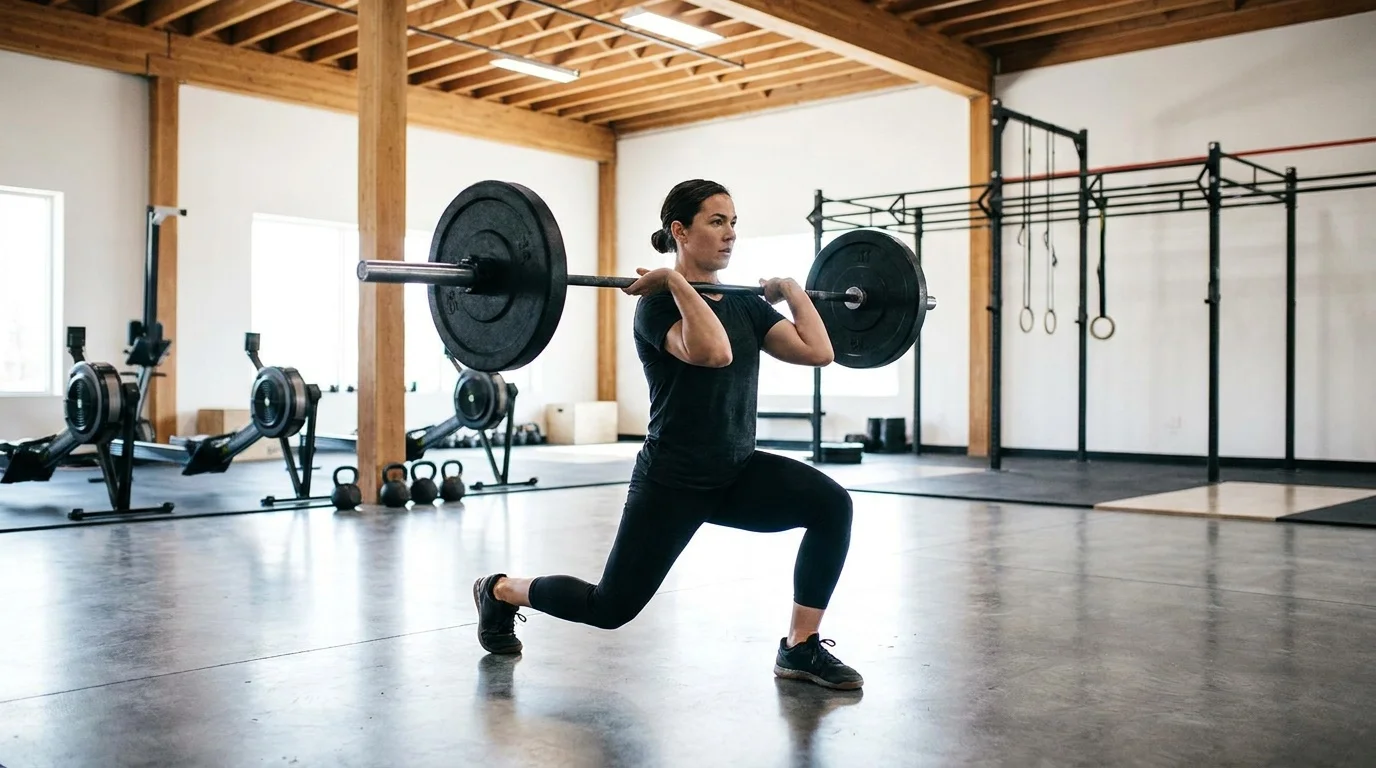
As the 12-week study on heavy slow resistance showed, slow lifting with challenging weights builds durable improvements in both pain and tendon tissue [2]. We load up squats, split squats, leg presses, and hack squats with a controlled tempo, taking several seconds to lower the weight and several seconds to drive it back up. We also look closely at your hips, ankles, and calf strength so the rest of your leg shares the workload.
Stage 3: Perform (Putting the spring back in)
Getting out of pain during slow lifting is only half the job. My goal isn't to get you back to normal; it's to get you back to being elite. If you return to box jumps, Olympic lifts, or fast running right out of slow strength work, the sudden return of spring-like forces can flare the knee right back up.
A 24-week randomized clinical trial tested a step-by-step progressive tendon-loading program against traditional eccentric-only exercises in 76 people who had been dealing with patellar tendon pain for about two years [4]. Most of these athletes (82%) had already tried prior treatments that failed to fix the problem [4]. By progressing the load in steps back to full sport, the progressive loading group improved significantly more on the standard patellar tendon questionnaire at 24 weeks (about 28 points compared to 18) [4].
Stage 4: Prevent (Staying durable for the long haul)
In the final phase, we blend your physical therapy directly into your ongoing strength and conditioning. You learn how to organize your weekly training volume, how to warm up before heavy squat or plyometric days, and what adjustments to make the very day you feel the first whisper of stiffness.
If you are tired of guessing which weights or workouts are safe for your knee, you can book a free discovery call to talk through your training and see how we would map out your rehab.
Rules for training while your tendon heals
Keeping you in the gym safely requires clear guardrails. In the clinic, we use a pain-monitoring model tested in a pilot study on active people with patellar tendinopathy [5]. Instead of telling athletes to stop all running and jumping, researchers allowed them to keep training as long as they followed two rules [5]:
- The 5/10 rule: Your pain can rise a bit during or right after your workout, up to a maximum of 5 out of 10, provided it feels manageable.
- The next-morning rule: Any uptick in soreness needs to settle back down to your normal baseline by the next morning. If your knee feels stiffer or more painful the next day during a simple test like a single-leg squat, the previous day's workout was a little too much.
While that study was a small pilot designed to show the approach is workable rather than prove it beats other methods [5], it gives us a practical, day-to-day gauge in the weight room.
To help you stay inside that safe window while we address patellar tendon pain when squatting, we often make temporary tweaks to your programming:
- Control the bottom of the lift: Pause squats and tempo squats take the elastic bounce out of the bottom of the hole, keeping the stimulus on your quads and glutes without snapping the tendon.
- Adjust your shin angle: Using a box squat, switching temporarily to a slightly more hip-dominant low-bar position, or adding heavy hinge work like deadlifts and RDLs lets you move heavy weight while trimming how far your knees travel forward over your toes.
- Consolidate your high-stress days: Tendons hate having heavy spring loads stacked back-to-back. Spacing out your heavy squat and jump sessions, instead of stacking them on back-to-back days, gives the tendon time to adapt.
When to get your knee checked out
While most patellar tendon soreness responds well to smart loading, some symptoms call for a prompt look. Consult a healthcare provider right away for a same-day medical check if you feel a sudden pop in the front of your knee, feel the knee give way underneath you, or lose the ability to straighten your leg on your own.
You should also have your knee evaluated if you notice obvious joint swelling, pain that wakes you up at night or throbs while you are sitting completely still, or pain that fails to budge after a few weeks of modifying your training loads.
If you are looking for physical therapy for knee pain in Waukee, you do not need to wait on a doctor's visit first. Iowa has direct access laws, which means no referral is needed to come see us. I work one-on-one with lifters, powerlifters, runners, and everyday athletes across Waukee, West Des Moines, Clive, Urbandale, Grimes, Johnston, Adel, and the greater Des Moines metro through our sports physical therapy programs.
Common questions about patellar tendonitis
Is patellar tendonitis the same as jumper's knee?
Yes. Jumper's knee is the common sports term for patellar tendonitis (or patellar tendinopathy). Both names describe irritation and overload in the tendon that connects the bottom of your kneecap to the top of your shinbone.
Should I stop squatting or jumping?
Rarely do you need to stop all lower-body training. We occasionally dial back the height or volume of your jumping for a short window while the tendon is highly reactive, and we may adjust your squat tempo, depth, or bar placement. In the pain-monitoring pilot study, keeping training active within a safe pain window (no higher than 5 out of 10 during training, and no worse the next morning) is a workable way to stay in your sport while you rehab [5].
How long is physical therapy for patellar tendonitis?
Every athlete's timeline is different and depends on how long the pain has been around, your training history, and the demands of your sport. In the clinical studies we covered earlier, structured rehab programs were tested over 12 weeks for heavy slow resistance [2] and 24 weeks for people with long-standing pain progressing back to full sport [4]. Because tendons adapt more slowly than muscles, our focus is on keeping you training productively throughout the process rather than rushing a quick fix that does not hold up.
Ready to fix your knee without sitting on the sidelines? You can book a free discovery call with me today, or send us a message through our contact page to get started at our Waukee clinic.
Disclaimer: This article is for general educational information only. It is not a medical diagnosis and does not replace an individualized exam from a licensed healthcare provider.
Sources
- Lian OB, Engebretsen L, Bahr R. Prevalence of jumper's knee among elite athletes from different sports: a cross-sectional study. American Journal of Sports Medicine, 2005. https://pubmed.ncbi.nlm.nih.gov/15722279/
- Kongsgaard M, Kovanen V, Aagaard P, et al. Corticosteroid injections, eccentric decline squat training and heavy slow resistance training in patellar tendinopathy. Scandinavian Journal of Medicine and Science in Sports, 2009. https://pubmed.ncbi.nlm.nih.gov/19793213/
- Rio E, Kidgell D, Purdam C, et al. Isometric exercise induces analgesia and reduces inhibition in patellar tendinopathy. British Journal of Sports Medicine, 2015. https://pubmed.ncbi.nlm.nih.gov/25979840/
- Breda SJ, Oei EHG, Zwerver J, et al. Effectiveness of progressive tendon-loading exercise therapy in patients with patellar tendinopathy: a randomised clinical trial. British Journal of Sports Medicine, 2021. https://pubmed.ncbi.nlm.nih.gov/33219115/
- Sprague AL, Couppe C, Pohlig RT, Snyder-Mackler L, Silbernagel KG. Pain-guided activity modification during treatment for patellar tendinopathy: a feasibility and pilot randomized clinical trial. Pilot and Feasibility Studies, 2021. https://pmc.ncbi.nlm.nih.gov/articles/PMC7905015/